
Recruiter Phone Screen: Questions, Short Answer Examples and a 30-Minute Practice Plan
Prepare for the first recruiter conversation: explain your fit briefly, give one concrete example and clarify expectations before the next stage.
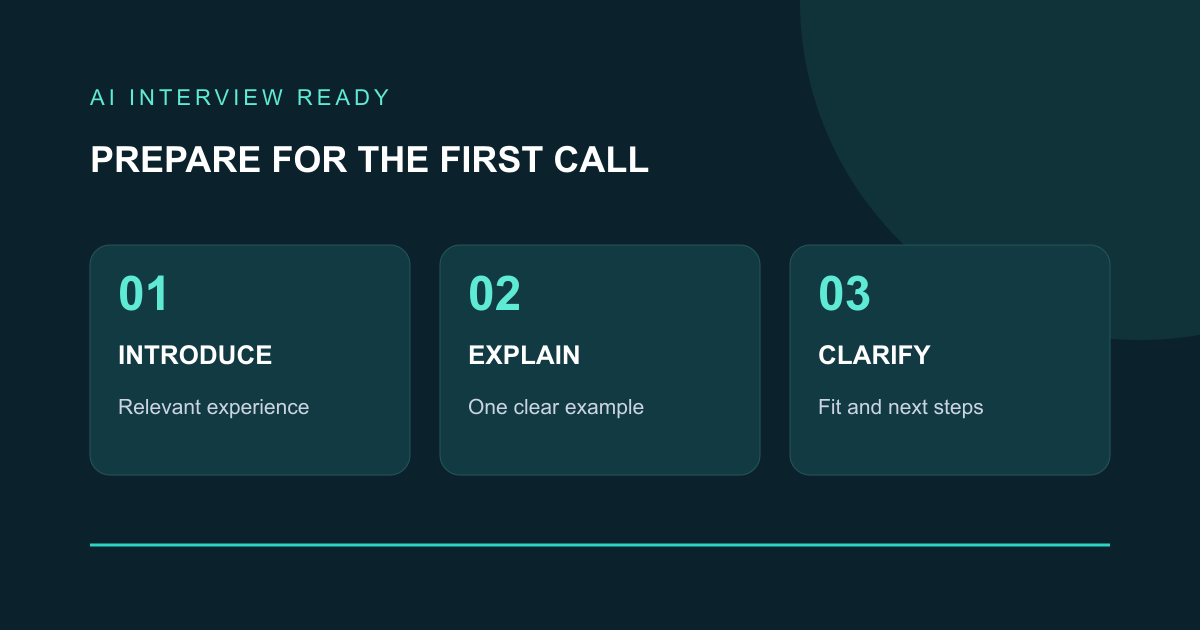
AI Interview Ready
For a recruiter phone screen, prepare a short introduction, a specific reason for wanting the role, one relevant project and accurate practical details. You should be able to explain the fit without walking through your entire CV. Use the examples below as structures to adapt to your own experience, then rehearse with the 30-minute plan.
A recruiter screen is an initial conversation about your background, motivation, role fit and practical expectations. Despite the name, it may happen by phone or video. A later technical or behavioral interview may explore your decisions and experience in more depth. Processes vary: a recruiter can ask substantive questions, and an initial call may combine several purposes. Check the invitation rather than assuming the stage or duration.
About the examples: all candidate situations, employers, projects and outcomes in this guide are fictional and illustrative. They are not customer accounts, research findings or scripts to present as your own. The preparation timings and scorecard are suggested exercises, not validated hiring assessments.
1. “Tell me about yourself”
Too general: “I'm a hard-working professional who enjoys working with people and wants a new challenge.”
More useful example: “I'm a customer success specialist supporting small business software customers. My work combines onboarding, usage reviews and renewal preparation. Recently, I coordinated a handoff checklist with Support so open issues had a named owner before account reviews. I'm interested in this role because it gives me more responsibility for onboarding and retention together.”
Why it improves: the recruiter hears the current role, relevant responsibilities, one concrete contribution and the reason for moving. The answer gives them a thread to follow instead of a list of personality claims.
Adaptable template: “I work in [relevant area], where I own [responsibility]. One example is [specific contribution]. I'm now looking for [next scope], which connects to your need for [role priority].” Start with a version you can say in about 45–60 seconds, then shorten or expand in response to the conversation.
If you are changing careers, connect the previous work to one real requirement: “In hospitality I handled service recovery and coordinated shift handoffs. I am moving toward customer support, and my course project gave me practice documenting issues in a ticket system.” Keep work experience and course experience distinct.
2. “Why this role, and why our company?”
Too general: “You have a great reputation and I want to grow at an innovative company.”
More useful example: “The posting combines customer onboarding with renewal preparation. I currently work across both, but ownership is split between teams. I'm interested in the chance to follow the customer through that transition. Your product page describes multi-location retailers as a customer group; I'd like to understand how their onboarding differs from smaller accounts.”
Why it improves: it links a responsibility to the candidate's experience and grounds the company interest in something they actually checked. It ends with a useful question instead of pretending to know the team's internal problems.
Template: “The role emphasises [responsibility]. I have [relevant experience] and want to take on [scope]. I noticed [fact from the posting or company site], and I'd like to learn [specific unknown].” Read the actual company page before using a fact. Do not invent a culture claim from a slogan.
3. “How does your experience match what we need?”
Example: “Your posting prioritises onboarding, account reviews and cross-team coordination. I run onboarding calls and prepare usage summaries for reviews. For coordination, I helped introduce the handoff checklist I mentioned. I have not owned enterprise renewals independently, so I'd like to understand the account size and level of negotiation responsibility here.”
Template: “[Requirement one] matches my work on [evidence]. For [requirement two], I have [evidence]. My gap is [specific boundary]; my related experience is [truthful connection].” Two strong connections are more useful than claiming you meet every bullet. If you cannot identify them, use the job-description guide to map the requirements before rehearsing.
4. “Can you describe a relevant project?”
Too general: “We improved onboarding and customers were much happier. I worked with several teams and it went very well.”
More useful example: “Support issues were being passed into account reviews without clear owners. I was responsible for making that handoff usable. I grouped the recurring issue types, drafted a checklist and tested it with two account managers and Support. The pilot gave every open item an owner and a next step. We still had a delay when engineering input was needed, which I flagged for the next revision.”
Why it improves: the candidate explains the problem, personal responsibility, action and observable result. The limitation makes the scope clear. No invented satisfaction score is needed.
Template: “We had [problem]. I owned [task]. I did [two important actions]. The result was [supported change], with [limit or learning].” Aim for a compact first answer, then offer to explain the details. Save the full chronology for a follow-up. The STAR guide covers longer behavioral examples when you reach that stage.
Check the substance of a role-specific answer
Create an account and add a target role or job description. Try three tailored questions with text answers and feedback; no card required. Questions are not a guaranteed recruiter-screen script.
5. “Why are you looking to leave?”
Example: “My current role has taught me a lot about reactive support. I now want ownership of planned onboarding and ongoing customer reviews. This posting includes both, which is why I applied.”
Keep the reason accurate and focused on the move you are making. If a role ended, say so plainly without inventing a voluntary departure: “My position ended during a team restructuring. I am looking for a role where I can use my onboarding experience.” You can explain a gap briefly and return to your readiness for the work; you do not need an elaborate personal narrative to fill silence.
Template: “[Brief truthful reason]. I'm looking for [scope or working arrangement], and this role appears to offer [connection worth checking].” Avoid attacking individuals or making promises about a new company you have not joined.
6. “When could you start? Does the working arrangement fit?”
Too vague: “I'm flexible. Any time should be fine.”
More useful example: “My notice period is four weeks, so I would confirm a start date after an offer and agreement with my current employer. I can attend your stated two office days each week. Could you confirm the office location and whether those days are fixed?”
Why it improves: it separates known constraints from details that still need agreement. Flexibility does not require promising a start date you cannot keep.
Template: “My earliest realistic start is [date or notice period], subject to [actual dependency]. I can work [confirmed location/hours arrangement]. I need to clarify [remaining detail].” If relocation, travel or work authorisation comes up, answer accurately for your circumstances and ask what the role requires. Do not guess at a requirement that has not been explained.
7. “What are your salary expectations?”
Decide what compensation arrangement you are discussing before comparing figures: currency, annual or hourly pay, base salary, variable compensation and working pattern. Choose a range you would actually consider, using information relevant to your location and role. Use the templates below to make the units and your expectations clear.
If the range is not published: “Could you share the budgeted base salary range and whether there is variable compensation? I'd like to check that we are discussing the same scope before giving a firm expectation.”
If you are ready to state a range: “For the responsibilities discussed, I'm targeting [currency X–Y] in annual base salary for a full-time role. The total package and final scope also matter. Is that within the budgeted range?”
If there is a mismatch: “Thank you for clarifying. My current target is above that range. Is there flexibility in the base salary or role level? If the budget is fixed, it may be best to establish that before the next stage.”
These are options to adapt, not rules every recruiter will accept. Avoid a range with a lower end you would reject. If you need to review new information, say when you can return with a considered answer.
8. “What would you like to ask me?”
Pick two or three questions the recruiter can reasonably help with. A question about team priorities may be answerable now; a detailed architecture decision may need the hiring manager.
- “Which requirements are essential for moving to the next stage?”
- “What is the hiring manager hoping this person will take ownership of first?”
- “Could you clarify the location, working pattern or salary range?”
- “What does the next stage assess, and is there anything I should prepare?”
- “When should I expect an update, and who is the best contact?”
Choose the question that resolves a real uncertainty. Listen to the answer before asking a prepared follow-up; the recruiter may already have covered it.
A 30-minute practice plan
| Minutes | Task | Output |
|---|---|---|
| 0–5 | Read the invite, posting and submitted CV. | Two fit points and the call's stated purpose. |
| 5–11 | Say your introduction and motivation aloud twice. | A clear opening that leaves space for questions. |
| 11–18 | Rehearse one relevant project; score it and retry. | A specific contribution and supported result. |
| 18–23 | Practise availability, working arrangement and compensation wording. | Accurate constraints and one clarification question. |
| 23–27 | Choose candidate questions; practise the close. | Two questions and a request for next steps. |
| 27–30 | Check audio/contact details and review your weakest answer. | A ready setup and a short keyword note. |
Practise aloud with a timer or a friend; no account is needed. Have the friend ask the questions in a different order so you practise answering rather than reciting. If using a recorder, review your own answer for content and length; you do not need a tool-generated score to identify an unsupported claim.
Copy this short-answer scorecard
For each substantive answer, give yourself 0 (missing), 1 (partly clear) or 2 (clear) on each line. For logistics answers, use the evidence line to check confirmed facts rather than trying to insert a project story.
| Check | What earns 2 points? |
|---|---|
| Relevance | I answered the actual question in the opening sentence. |
| Evidence | I gave a specific example or a confirmed practical fact; my contribution and limits are clear. |
| Brevity | I removed repeated background and left room for a follow-up. |
| Connection to the role | I explained why the experience matters here, or clarified a relevant working constraint. |
QUESTION:
RELEVANCE __/2   EVIDENCE __/2
BREVITY __/2     ROLE CONNECTION __/2
ONE DETAIL TO KEEP:
ONE SENTENCE TO CUT OR CLARIFY:
RETRY NOTE:
Use the total out of eight to compare your own attempts on the same question. It does not predict whether you will pass the screen. Fix the weakest dimension first; a shorter answer is only better if it still answers the question.
Prepare for what comes next
After the call, note the scope, constraints and next steps you learned. If you move to a behavioral stage, select examples with the 50 behavioral questions guide. For a video interview, use the remote interview setup guide. Those solve different tasks: deeper story practice and delivery logistics. If you have a fuller interview tomorrow, use the 60-minute preparation plan.
Make your experience easier to explain
Rehearse aloud yourself, then try AIR’s three free text questions for feedback. A CV is optional. Speech-to-text is available on Plus and Pro within plan limits.
Start free text practice →Share this article:
Ready to ace your next interview?
Practice with AI Interview Ready and get personalized feedback on your interview responses.
Start Practicing TodayRelated Articles
Interview Tomorrow? A 60-Minute Last-Minute Preparation Plan
A timed plan for the night before: three role priorities, two honest stories, one spoken rehearsal and a practical checklist you can use without an account.
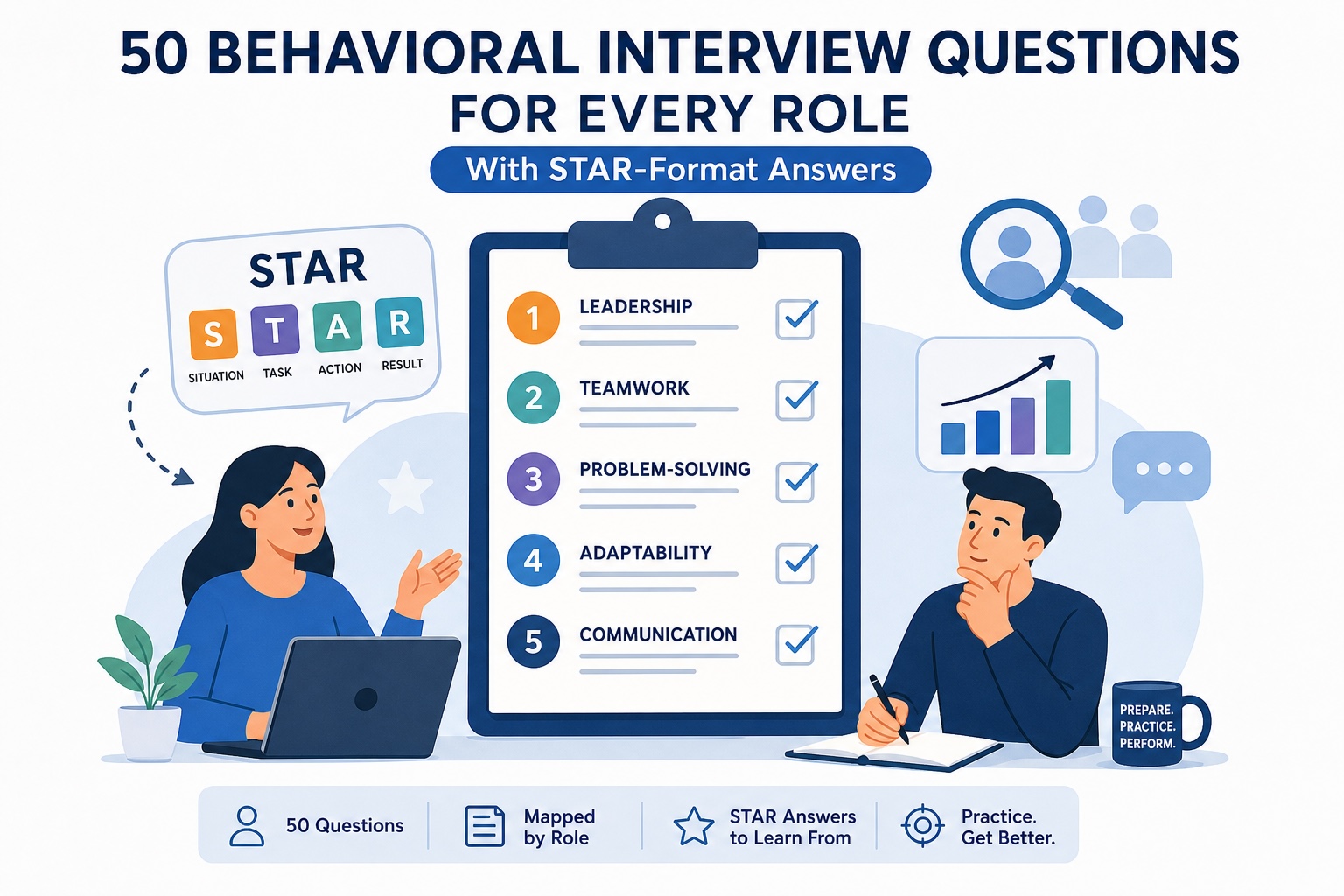
50 Behavioral Interview Questions (With STAR-Format Answers for Every Role)
50 behavioral interview questions organized by competency with STAR-format sample answers. Includes a role-mapping matrix for 14 roles so you know which questions to prepare for.

Remote Work Interview Mastery: AI-Powered Strategies for Virtual Success
Master virtual interviews with AI-powered strategies. Learn how to excel in remote work interviews and stand out in the digital hiring process.