The Complete Guide to the STAR Method: Examples, Scoring, and a Practice System That Actually Works
Patrick D.
Most professionals know what STAR stands for. Situation, Task, Action, Result — you've probably seen it in a dozen career advice articles. Yet when I was calibrating AI Interview Ready's scoring engine — testing it against hundreds of STAR answers across different roles and experience levels — the pattern was striking: answers that technically followed the STAR structure still scored poorly. People ramble through the setup, rush through the actions, and trail off without a result. The gap isn't knowledge — it's execution.
This guide is built from the practitioner side. I designed AIR's STAR scoring engine, which means I've spent months analyzing what separates a mediocre behavioral answer from one that makes interviewers lean forward. After scoring thousands of practice responses through the AIR platform, the patterns are consistent: candidates who structure their answers correctly score noticeably higher across all four dimensions of our rubric. What follows are real STAR method examples scored against that rubric, the specific mistakes I see most often, and a system for practicing that actually moves the needle. If you'd rather work alongside the reading, Sign up free to practice your own STAR responses with instant AI feedback — 3 questions, no credit card required. If you're preparing for behavioral interviews and want 50 behavioral interview questions with STAR answers, we've built that too — but start here first.
Practice STAR responses with AI feedback
Sign up free to access 3 practice questions — no credit card required.
Start practicing →What the STAR Method Actually Is (And Where It Came From)
The STAR method is a framework for answering behavioral interview questions using a specific four-part structure: you describe a Situation you were in, the Task you were responsible for, the Actions you took, and the Result you achieved. That's the simple version. The less simple version is that STAR isn't just a framework for candidates — it's an evaluation system designed for interviewers.
STAR was introduced in 1974 by Development Dimensions International (DDI), the leadership consulting firm that pioneered behavioral interviewing. DDI built it as part of their Targeted Selection system, grounded in a principle that's since been validated repeatedly: past behavior is the most accurate predictor of future performance. AI Interview Ready's scoring engine is built directly on this research — using the same four-component framework DDI introduced, translated into a machine-evaluable rubric that scores spoken answers in real time. The landmark Schmidt & Hunter meta-analysis, which synthesized 85 years of personnel selection research across 19 methods, found that structured interviews predict job performance with roughly twice the accuracy of unstructured ones. A 2022 meta-analysis led by Paul Sackett widened that gap further — structured behavioral interviews now show the highest predictive validity of any selection method, with more than double the power of unstructured interviews and measurably less bias.
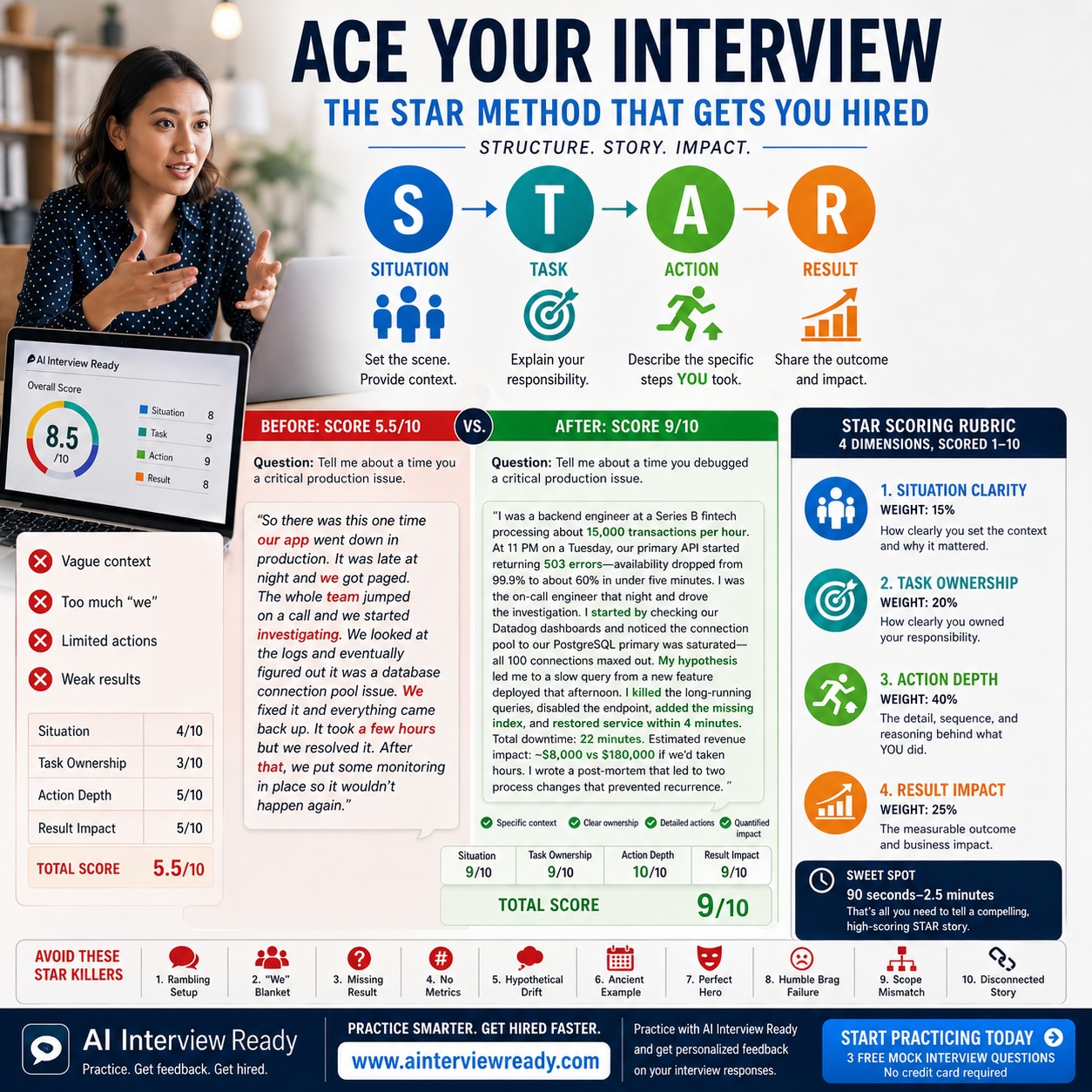
What does STAR stand for, exactly? Situation — the context and setting. Task — your specific responsibility or objective. Action — the concrete steps you took. Result — the measurable outcome. It seems simple, but the framework's power lies in its specificity. It forces you to move from the general ("I'm a good problem solver") to the particular ("Here's exactly what I did when the system went down at 11 PM on a Tuesday"). When I first mapped DDI's four-component framework to a scoring rubric, I found that the components aren't equally useful for automated evaluation. Situation and Task are mostly pass/fail — either you set context or you didn't. But Action Depth carries far more signal about a candidate's actual capability, which is how I ended up weighting it at 40% of the total score.
You'll sometimes see alternative frameworks mentioned in interview prep content. SOAR replaces Task with Obstacles. CAR strips it down to three parts. PAR takes a problem-focused lens. I've looked at enough STAR answers while calibrating AI Interview Ready's scoring engine to have opinions on these. SOAR sounds appealing in theory — who doesn't want to talk about obstacles they overcame? — but it creates a problem in practice: interviewers aren't listening for obstacles, they're listening for what you owned. SOAR users tend to spend too long describing how hard things were and not enough on what they specifically did about it. CAR has the opposite issue — by dropping Task entirely, you lose the component that reveals ownership and accountability. "I was responsible for X" is a sentence that carries real weight with an interviewer, and CAR skips it. STAR is the one to master first, for a simple reason: it's what interviewers are trained to evaluate against. Master this framework, and you can adapt to any variant on the fly.
What Interviewers Actually Score (The Part Nobody Tells You)
Here's what changes once you understand the interviewer's side. Trained behavioral interviewers don't just listen to your story — they're running a structured evaluation process that DDI calls "collecting STARs." They're listening for complete behavioral examples with all four components present, and they're making specific judgments on each one. Every time you say "usually what I do is..." instead of describing what you actually did, a trained interviewer mentally flags it. Every time you use "we" without clarifying your specific role, they note it. Every time your result is "things improved" without a number attached, they score it lower.
DDI's methodology also identifies what they call "false STARs" — answers that sound complete and structured but lack real behavioral substance. A false STAR might hit all four components technically while remaining so vague that the interviewer can't actually evaluate your capability. "I had a difficult project, I was in charge of it, I worked really hard, and it turned out great" checks every STAR box and says absolutely nothing.
What causes an interviewer to mentally check out? I call it the 30-second rule: if you haven't reached the Action portion of your answer within about 30 seconds, you're losing them. The "we" avalanche — where every sentence starts with team language and the interviewer can't isolate your individual contribution — is another killer. Missing metrics, over-rehearsed delivery that sounds memorized rather than recalled, and answers that stretch past three minutes all trigger disengagement. The sweet spot for a STAR answer is 90 seconds to 2.5 minutes. That's roughly the length of telling a friend about something interesting that happened at work — detailed enough to be compelling, concise enough to hold attention.
How long should a STAR answer be? The research underpinning AI Interview Ready's scoring engine — including MIT's STAR framework and DDI's interviewer training methodology — converges on 90 seconds to 2.5 minutes. Under 90 seconds usually means you're skipping the Action detail that drives your score. Over 2.5 minutes and you're likely rambling through context that doesn't add value. If you're hitting 3 minutes or beyond, the interviewer has almost certainly started formulating their next question instead of listening to your answer.
When I was designing AI Interview Ready's scoring algorithm, I studied DDI's interviewer training methodology and the behavioral interviewing literature extensively. The research is consistent: most candidates spend 60–70% of their answer on Situation and Task — the least important parts — then rush through Action and Result. Research and practitioner guidance — including from MIT Career Advising, DDI's original STAR framework, and our analysis of scored practice responses — converges on roughly 20% Situation, 10% Task, 60% Action, and 10–20% Result. That means your Action section should be the bulk of your answer — the detailed, step-by-step account of what you specifically did and why. If you're spending more than 20 seconds setting up context, you're already over budget.
Here's what's telling: LinkedIn's research on talent assessment shows the majority of hiring leaders now prioritize soft skills — exactly what behavioral interviews are designed to measure. But the interviewer evaluation literature reveals a consistent disconnect that I built AI Interview Ready's weighting around: candidates think interviewers are evaluating what happened (the Situation and Result), when in reality the heaviest weight falls on what you did and how you thought about it (Action Depth). People over-invest in setting the scene and landing a big number at the end, while rushing through the part the interviewer actually cares about most.
The AI Interview Ready STAR Scoring Rubric: 4 Dimensions, Scored 1-10
This rubric powers AI Interview Ready's scoring engine — when you practice a mock interview on the platform, this is exactly how your spoken answers get evaluated. It's built on four dimensions, each weighted according to how much it matters in the interviewer evaluation literature. The AI Interview Ready STAR Scoring Rubric weights Action Depth at 40% because that's the dimension where the research shows the most variance between strong and weak candidates — and where I saw the clearest signal separation while calibrating the scoring engine.
SHRM's interviewing toolkit recommends behaviorally anchored rating scales for structured hiring — and translating that concept into a scoring algorithm is where it got interesting. The hardest part wasn't defining "strong" versus "weak" in the abstract. It was operationalizing the boundary between, say, a 6 and a 7 on Action Depth. A human interviewer feels that distinction intuitively. A scoring engine needs explicit signals: did the candidate describe sequential steps? Did they explain why they chose one approach over another? Did they mention a trade-off? Those are the kinds of markers that separate adequate from strong when a machine is doing the evaluation.
Dimension 1: Situation Clarity — Weight: 15%
| Score Range | Level | What It Sounds Like |
|---|---|---|
| 1–3 | Weak | "At my last job..." No specifics on when, where, team size, or stakes. |
| 4–6 | Adequate | Basic context provided but lacking key details. May run over 30 seconds. |
| 7–8 | Strong | Specific in 2–3 sentences. Company type, role, timeline, why it mattered. |
| 9–10 | Exceptional | Crisp, compelling context delivered in under 20 seconds. Scale, stakes, and relevance to the target role are immediately clear. |
Dimension 2: Task Ownership — Weight: 20%
| Score Range | Level | What It Sounds Like |
|---|---|---|
| 1–3 | Weak | No personal responsibility. "We" used exclusively. Impossible to tell what the candidate owned. |
| 4–6 | Adequate | Some personal responsibility mixed with team language. Individual contribution unclear. |
| 7–8 | Strong | Clear "I" language. "I was responsible for..." Distinct from team contributions. |
| 9–10 | Exceptional | Unmistakable ownership with clear scope. Shows initiative beyond the assigned responsibility. |
Dimension 3: Action Depth — Weight: 40%
| Score Range | Level | What It Sounds Like |
|---|---|---|
| 1–3 | Weak | Vague or hypothetical. "I worked hard." Uses "would" instead of "did." |
| 4–6 | Adequate | Some specific actions but lacks step-by-step detail. Missing the "how" and "why." |
| 7–8 | Strong | Clear step-by-step account with rationale. Shows decision-making process. |
| 9–10 | Exceptional | Vivid, detailed, multiple steps with reasoning. Reveals thinking under pressure and trade-off decisions. |
Dimension 4: Result Impact — Weight: 25%
| Score Range | Level | What It Sounds Like |
|---|---|---|
| 1–3 | Weak | No result or completely vague. "It worked out." No metrics, no business connection. |
| 4–6 | Adequate | Result mentioned but unquantified. "We delivered on time." |
| 7–8 | Strong | Quantified with business connection. "Revenue increased 23% that quarter." |
| 9–10 | Exceptional | Multiple quantified results plus learning or reflection. Shows both business impact and growth mindset. |
Score your own STAR response
Sign up free to access 3 practice questions — no credit card required.
STAR Method Examples: A Scored Before/After Pair
Reading about the rubric is useful. Seeing it applied to real answers is where it clicks. The examples below are scored using the AI Interview Ready STAR rubric — the same four-dimension scoring framework the platform applies to your spoken mock interview answers. Two STAR interview technique examples follow — one from a software engineering context, one from marketing — each showing the same question answered at a 5/10 level and then at a 9/10 level. These are written to sound like spoken language because that's how you'll actually deliver them.
Software Engineer — Production Outage
Question: "Tell me about a time you debugged a critical production issue."
Version A — Score: 5.5/10
(Situation: 4 | Task Ownership: 3 | Action Depth: 5 | Result: 5)
"So there was this one time our app went down in production. It was late at night and we got paged. The whole team jumped on a call and we started investigating. We looked at the logs and eventually figured out it was a database connection pool issue. We fixed it and everything came back up. It took a few hours but we resolved it. After that, we put some monitoring in place so it wouldn't happen again."
What goes wrong here: "our app" gives no scale or context. Every action is "we" — a trained interviewer can't tell what this person specifically did versus what their teammates handled. "We looked at the logs" skips the entire diagnostic methodology. And "it took a few hours" with "we put monitoring in place" is a result with no quantification and no sense of impact.
Version B — Score: 9/10
(Situation: 9 | Task Ownership: 9 | Action Depth: 10 | Result: 9)
"I was a backend engineer at a Series B fintech processing about 15,000 transactions per hour. At 11 PM on a Tuesday, our primary API started returning 503 errors — availability dropped from 99.9% to about 60% in under five minutes. I was the on-call engineer that night. Three of us got on a call, but I drove the investigation. I started by checking our Datadog dashboards and noticed the connection pool to our PostgreSQL primary was saturated — all 100 connections maxed out. My first hypothesis was a traffic spike, but our request volume was normal. So I dug into the slow query log and found a query from a new analytics feature deployed that afternoon — it was running a full table scan on a 40-million-row table without an index, and each execution held a connection for 12 seconds. I made the decision to kill the long-running queries immediately and temporarily disable the analytics endpoint. That restored service within 4 minutes. Then I added the missing index, verified the query plan dropped from 12 seconds to 80 milliseconds, and re-enabled the endpoint by midnight. Total downtime: 22 minutes. Estimated revenue impact: about $8,000 in failed transactions, compared to roughly $180,000 if we'd taken the full hours my teammates' initial approach of restarting services would have needed. I wrote a post-mortem the next morning that led to two process changes: mandatory query plan reviews for any migration touching tables over 1 million rows, and connection pool alerting at 80% utilization."
What changed: generic context became a fintech with scale. "We investigated" became a systematic diagnostic methodology with clear hypothesis testing. The result includes quantified downtime, revenue impact, a counterfactual comparison, and process changes that prevented recurrence. Every action has a rationale attached.
Marketing Manager — Failed Campaign
Question: "Tell me about a campaign that didn't work and what you learned."
Version A — Score: 5/10
(Situation: 4 | Task Ownership: 5 | Action Depth: 4 | Result: 5)
"Last year we ran a social media campaign that didn't perform well. The engagement was lower than expected and we didn't hit our lead targets. I think the issue was that the messaging didn't resonate with our audience. We went back and adjusted the messaging and the next campaign did better. I learned the importance of testing messaging before launching."
What falls flat here: "social media campaign" — which platform? Which audience? What budget? "Lower than expected" — lower than what, specifically? "I think the issue was" signals the candidate doesn't actually know. And "the next campaign did better" is a result without a single number attached. An interviewer hearing this would have to ask four or five follow-up questions just to understand what actually happened.
Version B — Score: 9/10
(Situation: 9 | Task Ownership: 9 | Action Depth: 9 | Result: 9)
"I led a product launch campaign for a cybersecurity SaaS tool targeting mid-market IT directors. I allocated $45K of our quarterly budget to a LinkedIn campaign with three ad variants — all focused on feature comparisons against competitors. After two weeks, we'd spent $18K and generated 23 leads versus our target of 150 for the month. Cost per lead was $780 — our benchmark was $120. I paused the campaign and spent two days analyzing what went wrong. The click-through rate was actually solid — 2.1%, above benchmark. The problem was post-click: our landing page had a 94% bounce rate. People clicked the ad, hit the page, and left immediately. I realized our ads promised 'see how we compare to CrowdStrike' but the landing page was a generic product overview — no comparison content at all. It was a bait-and-switch. I rebuilt the landing page to deliver exactly what the ad promised: an interactive comparison table with feature-by-feature breakdowns. I also swapped the form from a 7-field lead form to a 3-field version gated behind the full comparison PDF. We relaunched with the remaining $27K. Over the next three weeks, we generated 189 leads at $143 CPL. Not quite our $120 target, but a 5.5x improvement. I now run a 'promise-page audit' before every campaign launch — checking that what the ad says and what the landing page delivers are identical. That single process change improved our average campaign CPL by 31% over the following two quarters."
What changed: vague "social media campaign" became a specific channel, audience, and budget. "Messaging didn't resonate" became a precise root-cause diagnosis with supporting data. The generic learning became a reusable process with quantified long-term impact. Notice how the failure itself is a strength — this answer demonstrates analytical thinking, ownership, and the ability to course-correct under pressure.
We have 12 role-specific scored examples in our companion article covering roles from data science to consulting to product management — each with the same before/after format and dimension-level scoring.
The 10 Mistakes That Kill STAR Answers
These are the patterns that consistently pull scores down. I've ordered them by how frequently they showed up while I was calibrating AI Interview Ready's scoring engine — not by severity, though the first three are both frequent and severe.
1. The Rambling Setup. Forty-plus seconds of context before any action begins. "So I was working at this company — it was a mid-sized company, about 300 people, based in Chicago, we were in the healthcare space..." Fix: two to three sentences of context, maximum. If it doesn't directly set up the action, cut it.
2. The "We" Blanket. "We decided to restructure the process. We built a new dashboard. We presented to leadership." An interviewer hears this and thinks: but what did you do? Fix: replace "we decided" with "I proposed." Replace "we built" with "I led the development of" or "I built the front-end while my colleague handled the API."
3. The Missing Result. The story just... stops. "...and yeah, so that's basically how I handled that situation." Fix: every STAR answer ends with a specific outcome. If the project is still in progress, give the results so far and what you expect.
4. The Unquantified Result. "The project was a success and stakeholders were happy." Fix: attach a number. Revenue, time saved, percentage improvement, NPS change, error rate reduction — anything measurable. "Customer satisfaction scores went from 3.2 to 4.1 within two months" is miles better than "customers were happier."
5. The Hypothetical Drift. "If I were in that situation, I would probably start by..." Behavioral questions ask for what you did, not what you'd theoretically do. Fix: past tense, actual behavior only. "I started by..." not "I would start by..."
6. The Ancient Example. Sharing a college story when you have ten years of professional experience. Fix: keep examples from the last three to five years unless the question specifically asks about early career or academic experience.
7. The Perfect Hero. "I immediately identified the root cause and implemented a flawless solution that exceeded all expectations." Nobody believes this because real work doesn't happen this way. Fix: show the mess. Mention the wrong hypothesis you tested first, the stakeholder pushback you had to navigate, the trade-off you had to make. Imperfection signals authenticity.
8. The Humble Brag Failure. "My biggest weakness? I just care too much about quality." Interviewers have heard this thousands of times and it signals low self-awareness. Fix: describe a genuine failure with real consequences, then pivot to what you changed as a result. The learning is the point, not the failure.
9. The Scope Mismatch. Interviewing for a director role and talking about the time you organized a team lunch. Or interviewing for an individual contributor position and only talking about strategy without any execution detail. Fix: match the scope and complexity of your story to the seniority of the target role.
10. The Disconnected Story. A leadership question answered with an example that demonstrates organization but not leadership. "Tell me about leading through change" answered with "I planned the office move." Fix: before answering, identify the actual competency being tested and pick a story that directly demonstrates it.
I designed AI Interview Ready's practice flow around the story bank approach because DDI's own research shows that candidates with prepared, structured examples consistently outperform those who improvise. Preparation isn't optional — it's the foundation the scoring engine is built to reward.
How to Build Your STAR Story Bank
The concept is straightforward: instead of trying to think of answers on the spot in an interview, you prepare 8–10 strong stories in advance that you can adapt to a wide range of questions. A well-chosen story bank means you're never starting from scratch — you're selecting and adjusting from a prepared set.
The key is covering eight core competency themes that come up across virtually every behavioral interview, regardless of role or industry: Achievement, Failure and Recovery, Conflict Resolution, Initiative, Leadership, Data-Driven Decision Making, Collaboration, and Adapting to Change. How many STAR stories should you prepare? Industry consensus and DDI's interviewer training materials suggest eight to ten stories cover the majority of behavioral questions — that's the number AI Interview Ready's practice system is built around. Eight to ten from the past three to five years, covering these eight themes, gives you enough range to handle virtually any behavioral question without repeating yourself.
Each story in your bank should map to one primary theme but flex across three to five related questions by shifting which details you emphasize. This is the real leverage — versatility. You're not memorizing 50 separate answers. You're preparing 10 adaptable stories that cover the full competency landscape.
For example, a single story about turning around a failing product launch could answer "Tell me about a time you failed," "Describe a time you had to adapt your strategy," "Give me an example of data-driven decision making," and "Tell me about a time you influenced without authority" — depending on which thread you pull forward. When an interviewer asks about failure, you lead with what went wrong and what you learned. When they ask about data-driven decisions, you lead with the analysis that informed your pivot. Same story, different framing, different emphasis — and it sounds natural each time because you're drawing from a real experience, not reciting a script.
The template for each story is simple: the situation in two to three sentences with specific scale and stakes, your specific task and ownership, a step-by-step action sequence with reasoning, and quantified results plus a reflection on what you learned or what you'd do differently. Keep each draft under 300 words written, knowing it'll expand slightly when spoken. The writing is scaffolding — what matters is being able to deliver it verbally with confidence and natural phrasing.
We've built a complete story bank system and 7-day practice plan with a downloadable template, daily exercises, and competency mapping — if you want the full system, that companion piece walks through every step.
From Reading to Practicing: Why Speaking Matters More Than Writing
Here's the thing that most STAR method guides won't tell you: writing good STAR answers and speaking good STAR answers are fundamentally different skills. Writing gives you time to edit, restructure, and polish. Speaking demands that you organize your thoughts in real time, manage pacing, and land your result cleanly — all while someone is watching you and taking notes.
The research on deliberate practice is unambiguous: speaking an answer aloud uses different cognitive processes than writing it. Writing lets you gloss over transitions and skip the reasoning — when you're speaking, those gaps are immediately obvious, both to you and to whoever is listening. That's why AI Interview Ready scores your spoken answers — what you actually say under slight pressure, not what you planned to write.
The practical advice is simple. First, record yourself answering a behavioral question out loud — most people are shocked at how different their spoken answer sounds from what they'd imagined. Second, use a timer. If you're consistently over 2.5 minutes, you need to cut context. If you're under 90 seconds, you're probably skipping the Action detail that drives your score. Third, if you want structured feedback on your spoken answers, try an AI mock interview tool. AI Interview Ready scores your spoken responses against the four-dimension rubric you saw above and gives you specific, actionable feedback on where to improve.
Try AI feedback on a spoken answer
Sign up free to access 3 practice questions — no credit card required.
Whether you use AI Interview Ready or record yourself on your phone, the principle is the same: the STAR method interview is a spoken performance, and you can't prepare for a spoken performance by only writing. Read the frameworks, study the examples, build your story bank — but then practice out loud. Time yourself. Listen back. Notice where you ramble, where you lose the thread, where your result fizzles instead of landing. That's where the improvement actually happens.
Is the STAR method outdated? Not even close. The Sackett 2022 meta-analysis confirms that structured behavioral interviews remain the single highest-validity selection method available. AI Interview Ready's scoring engine is built on the same principle the research supports: structured answers produce more evaluable, more compelling responses than unstructured narratives. The framework has been around for over 50 years because it works — both for interviewers trying to make good hiring decisions and for candidates trying to communicate their experience clearly. What's changed isn't the method but the tools available to practice it. You no longer need a patient friend or a career coach charging $200 an hour to get quality feedback on your behavioral answers. But you do need to practice. And you need to practice speaking, not just reading.
Start with the rubric. Study the examples. Build your story bank. Then open your mouth and practice.
Sources and References
- Development Dimensions International (DDI), "The STAR Method" — Origin of the STAR framework (1974) and the Targeted Selection behavioral interviewing system.
- Development Dimensions International (DDI), "Behavioral Interviewing" — Overview of the "collecting STARs" evaluation methodology used by trained interviewers.
- Development Dimensions International (DDI) via ATD, "Everything You Ever Needed to Know About the STAR Format" — The concept of "false STARs" and partial STARs in interviewer evaluation.
- Schmidt, F.L. & Hunter, J.E. (1998), "The Validity and Utility of Selection Methods in Personnel Psychology", Psychological Bulletin, 124(2). — Meta-analysis of 85 years of personnel selection research; structured interview validity of .51 vs .38 for unstructured.
- Sackett, P.R. et al. (2022), summary via Criteria Corp — Updated meta-analysis confirming structured interviews as the highest-validity selection method.
- MIT Career Advising and Professional Development, "The STAR Method for Behavioral Interviews" — Recommended time allocation: 20% Situation, 10% Task, 60% Action, 10–20% Result.
- LinkedIn Talent Solutions, "Behavioral Interview Questions for Soft Skills" — Research on hiring leaders prioritizing soft skills in behavioral evaluations.
- SHRM, "Transform Interviewing Into Strategic Talent Selection" — Structured interviewing toolkit and behaviorally anchored rating scales (BARS).
Tags:
Share this article:
Ready to ace your next interview?
Practice with AI Interview Ready and get personalized feedback on your interview responses.
Start Practicing TodayRelated Articles

Why You Must Practice Interviews Out Loud: The Science of AI Speech Coaching
Passive reading fails as interview prep—verbal practice succeeds. 74% of candidates report mock interviews are most helpful. Learn why speaking answers aloud with AI speech coaching is the critical factor in converting preparation into job offers.

Behavioral Interview Questions: AI Analysis of Top Patterns and Winning Answers
Discover how AI analyzes thousands of behavioral interview questions to identify winning patterns and help you craft compelling STAR method responses.

The Science Behind Mock Interview Practice: Does It Actually Work?
Discover the scientific evidence behind mock interview practice. Research shows 84% of candidates felt better prepared, anxiety dropped significantly, and practice sessions doubled hiring success rates. Learn how many mock interviews you need and what type of practice works best.