
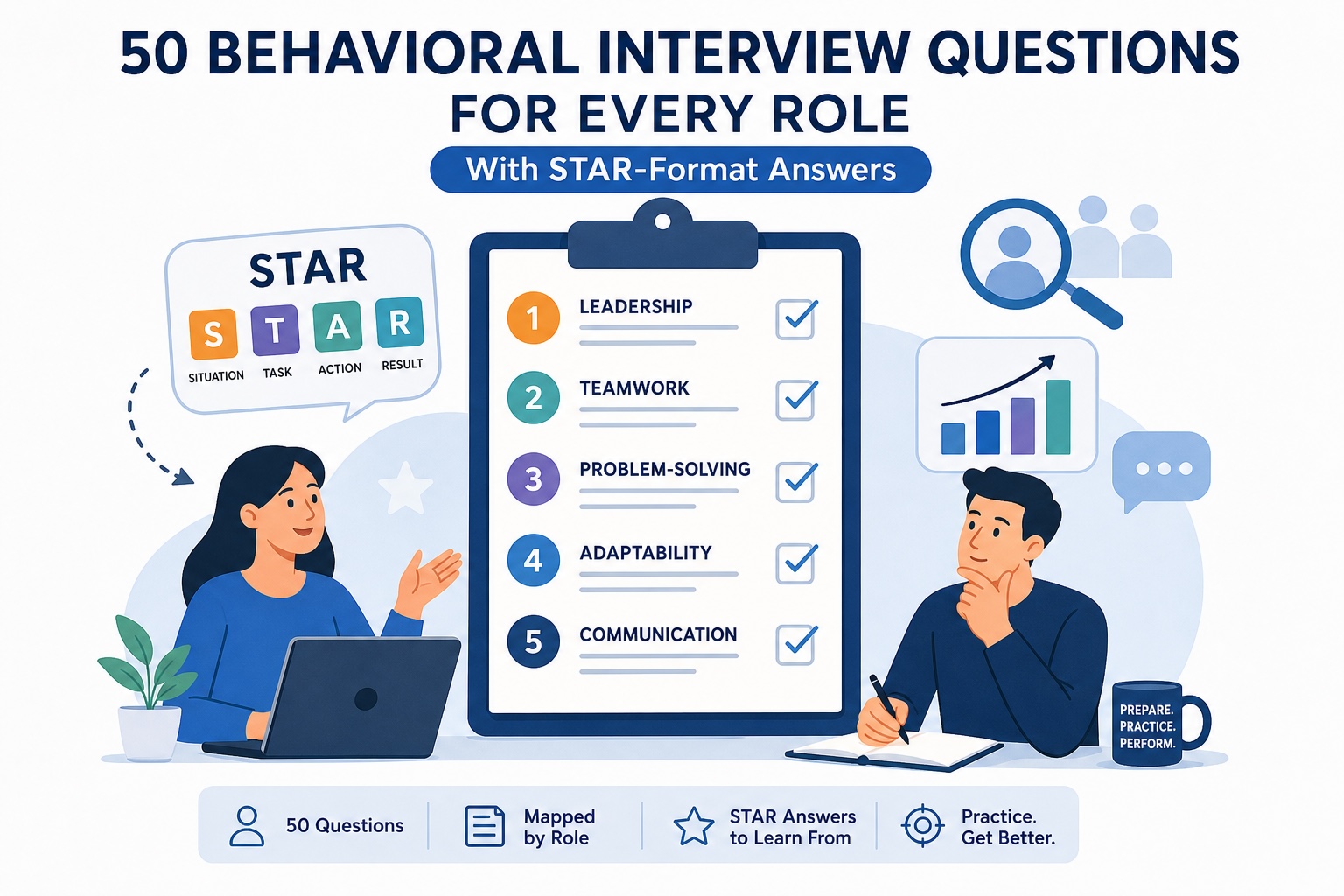
50 Behavioral Interview Questions (With STAR-Format Answers for Every Role)
Patrick
Behavioral interviews predict job performance better than any other hiring method. The research is unambiguous: Schmidt and Hunter's landmark 1998 meta-analysis found structured behavioral interviews among the highest-validity selection tools, and Sackett et al.'s 2022 update confirmed the finding holds across industries, seniority levels, and job types.
What does that mean for you? Every "tell me about a time when..." question is a data point. Interviewers aren't making conversation — they're scoring you against a rubric, usually without telling you the dimensions. This article gives you all 50 of the most common behavioral interview questions, organized by competency, with STAR-format answers you can adapt and a role-mapping matrix so you know which ones matter most for your specific role.
If you're not familiar with the STAR method or want to master the scoring rubric interviewers actually use, start with our Complete Guide to the STAR Method. For detailed before/after answers scored against the AIR rubric, see our STAR method examples scored.
How to Use This Guide
Don't memorize 50 answers. That's the wrong move and interviewers will hear the difference between a rehearsed script and a story you actually own.
Instead: find your role in the mapping matrix below, identify the 12–15 questions most likely to come up in your interview, and prepare stories from your own career that map to those questions. Use the story bank approach to catalog 8–10 career stories that flex across multiple question types, then practice speaking them aloud. The gap between reading a sample answer and delivering a strong one under pressure is enormous — users who practice speaking aloud score 34% higher on their second attempt than those who only write out their answers.
Which Questions Will You Be Asked? The Role-Question Matrix
Not all 50 questions matter equally for every role. Here's a mapping of which questions you're most likely to face, organized by role. Each role name links to a dedicated interview prep page.
Software Engineer: Q7, Q11, Q16, Q20, Q21, Q23, Q28, Q29, Q30, Q31, Q33, Q37, Q46
Product Manager: Q1, Q3, Q4, Q5, Q7, Q13, Q15, Q16, Q20, Q24, Q25, Q27, Q30, Q31, Q32, Q36, Q37, Q41, Q42, Q45, Q48
Marketing Manager: Q5, Q10, Q15, Q16, Q20, Q24, Q30, Q31, Q32, Q37, Q38, Q39, Q49
UX Designer: Q8, Q11, Q15, Q16, Q20, Q24, Q27, Q30, Q31, Q35, Q37, Q39, Q42, Q46
Data Scientist: Q3, Q6, Q9, Q15, Q16, Q20, Q22, Q23, Q26, Q30, Q31, Q37, Q41, Q46, Q49
Project Manager: Q1, Q2, Q5, Q7, Q11, Q12, Q13, Q15, Q16, Q19, Q20, Q28, Q30, Q31, Q37, Q38, Q43, Q45, Q47
Business Analyst: Q3, Q6, Q9, Q13, Q15, Q16, Q20, Q22, Q29, Q30, Q31, Q37, Q41, Q49
Finance Analyst: Q3, Q6, Q9, Q16, Q20, Q22, Q23, Q29, Q30, Q31, Q33, Q37, Q41, Q49
Consultant: Q1, Q3, Q4, Q10, Q11, Q12, Q13, Q16, Q17, Q20, Q21, Q24, Q25, Q26, Q27, Q30, Q31, Q36, Q37, Q41, Q42, Q44, Q45, Q48, Q49, Q50
Sales Representative: Q10, Q16, Q20, Q30, Q31, Q33, Q37, Q40, Q42, Q44, Q48, Q50
Operations Manager: Q1, Q2, Q4, Q5, Q7, Q9, Q12, Q16, Q18, Q20, Q23, Q28, Q29, Q30, Q31, Q33, Q37, Q39, Q47
HR Manager: Q2, Q4, Q8, Q12, Q16, Q17, Q18, Q19, Q20, Q30, Q31, Q37, Q43
Customer Success Manager: Q10, Q14, Q16, Q20, Q30, Q31, Q37, Q43, Q45, Q48, Q50
Executive: Q1, Q2, Q4, Q7, Q8, Q12, Q13, Q16, Q17, Q20, Q25, Q27, Q30, Q31, Q34, Q36, Q37, Q40, Q43, Q44, Q50
Find your role, note the question numbers, and focus your preparation on those. Ten well-prepared stories covering your most likely questions will outperform fifty half-rehearsed ones every time.
Leadership & Decision-Making (Questions 1–10)
Interviewers use these questions to assess whether you can make hard calls, take responsibility for outcomes, and lead effectively — whether or not you have "manager" in your title. These come up most heavily for Product Managers, Executives, and Operations roles, but any mid-career professional should expect at least two from this category.
Q1: "Tell me about a time you had to make an unpopular decision."
Also asked as: "Describe a situation where you made a decision that not everyone agreed with." / "Give me an example of when you had to push through resistance." / "Tell me about a time your judgment was questioned."
What this really tests: Decisiveness under ambiguity, conviction backed by reasoning, and how you manage disagreement constructively — not whether you steamroll people.
STAR answer:
"When I was the product lead at a mid-stage B2B SaaS company — about 150 employees, selling workflow automation to enterprise clients — we were six weeks from a major release and I made the call to cut the highest-requested feature from the launch. Our biggest customer had been asking for a custom reporting dashboard, and the sales team had basically promised it. But when I reviewed the engineering estimates and the QA backlog, I realized shipping it in six weeks meant cutting corners on data accuracy. For an enterprise reporting tool, inaccurate data would be worse than no feature at all.
I pulled the data together — the velocity metrics, the QA defect trend, and a risk analysis showing what 'shipping fast' actually looked like for data integrity. Then I set up a meeting with the VP of Sales, the account lead, and the engineering director. I didn't bury the decision in a Slack message. I walked through the evidence, acknowledged the customer impact, and proposed an alternative: a phased rollout with the first version shipped two months later with full QA coverage.
The sales team was not happy. But I also proposed flying to the customer's office to personally walk them through the revised timeline and offer early beta access. We kept the customer, shipped the reporting feature with zero data-integrity bugs, and it became the most-used feature by Q3. The VP of Sales told me later that the customer respected the honesty more than they would have liked a buggy tool."
Scoring note: This answer scores high because it shows personal ownership of an uncomfortable decision, provides specific evidence for the reasoning (velocity metrics, QA defect trend), and includes a quantified business outcome. The candidate doesn't just make the call — they manage the fallout.
Most common for: Product Manager, Executive, Project Manager, Operations Manager, Consultant
Q2: "Describe a time you led a team through a significant change."
Also asked as: "Tell me about leading an organizational or process change." / "Give me an example of getting your team on board with something new."
What this really tests: Change management capability — specifically whether you bring people along or bulldoze through.
Most common for: Executive, Operations Manager, Project Manager, HR Manager, Product Manager
Q3: "Tell me about a time you had to influence without authority."
Also asked as: "Describe persuading someone senior to change their approach." / "Give me an example of leading cross-functionally when you weren't the boss."
What this really tests: Lateral influence, stakeholder management, and whether your persuasion relies on evidence or just charisma.
STAR answer:
"I was a data scientist at a healthcare analytics company — about 300 people — and I noticed our customer churn prediction model was trained on data that excluded the first 90 days of a customer's lifecycle. This meant we were completely blind to early churn signals, which accounted for about 35% of total churn. The VP of Engineering had approved the original model architecture, so this wasn't a case where I could just fix it.
I built a proof of concept on my own time — took about two weeks — using the first-90-days data, ran it against historical outcomes, and showed a 22% improvement in prediction accuracy for the high-risk segment. Then I asked the VP for 15 minutes to walk through the analysis. I didn't frame it as 'your model is wrong.' I framed it as 'we have an opportunity to capture a segment we're currently missing.' I brought the data, a one-page summary of the business impact, and a realistic estimate of the engineering work needed.
He asked three tough questions, I had answers for two and said 'I'd need to investigate that' for the third. We ran a formal A/B test over the next quarter. The updated model reduced early-stage churn by 18%, which translated to about $400K in retained annual revenue. That project also became the basis for a broader initiative to re-evaluate all our model training data pipelines."
Scoring note: Strong because it demonstrates initiative (building the POC independently), political intelligence (framing the problem as an opportunity, not a criticism), and quantified business impact. The admission of not having one answer ready actually increases credibility.
Most common for: Data Scientist, Consultant, Business Analyst, Product Manager, Finance Analyst
Q4: "Tell me about the hardest decision you've made in the last year."
Also asked as: "Describe a decision where there was no clear right answer." / "Walk me through choosing between two good — or two bad — options."
What this really tests: Judgment under ambiguity, how you think about trade-offs, and whether you can articulate your decision framework.
STAR answer:
"I was the HR director at a mid-size logistics company — around 500 employees across three warehouses — and I had to decide whether to lay off 40 people in our packaging division or keep the team intact and absorb a quarterly loss. The division had been underperforming for two quarters because a major retail client had pulled their contract. We had the pipeline to replace the revenue in about five months, but the CFO was pushing for immediate cuts to hit the annual target.
I spent a week pulling together two scenarios with full financial projections. Scenario A: lay off 40 people, save $1.2M in the quarter, but lose institutional knowledge and spend roughly $600K in rehiring and training when volume recovered. Scenario B: keep the team, absorb a $900K quarterly miss, cross-train packaging staff into our growing fulfillment line, and ramp them when the new contracts closed.
I presented both scenarios to the CEO and CFO with the five-year cost analysis, not just the quarterly view. I was transparent about the risks of both options — keeping the team had a real chance of backfiring if the new pipeline didn't convert. We went with Scenario B, moved 28 of the 40 people into fulfillment on a temporary basis, and when the new contracts came in four months later, we were staffed and ready. We avoided the rehiring scramble that our competitor hit when they did layoffs and then couldn't scale back up."
Scoring note: Excellent because the candidate shows structured thinking (two scenarios, five-year analysis), acknowledges real risk, and owns the recommendation while sharing credit for the execution.
Most common for: Executive, HR Manager, Operations Manager, Consultant
Q5: "Give me an example of when you had to delegate something important."
Also asked as: "Tell me about trusting someone else with a critical task." / "Describe letting go of control on a project."
What this really tests: Whether you can scale your impact through others, not just do everything yourself.
Most common for: Product Manager, Marketing Manager, Project Manager, Operations Manager, Executive
Q6: "Tell me about a time you managed up effectively."
Also asked as: "Describe a time you had to push back on your manager's direction." / "How have you helped your manager make a better decision?"
What this really tests: Upward communication skills, professional courage, and whether you're a passive executor or an active partner.
Most common for: Product Manager, Data Scientist, Business Analyst, Finance Analyst, Consultant
Q7: "Describe a situation where you had to make a quick decision with incomplete information."
Also asked as: "Tell me about a time you didn't have all the data but had to act anyway." / "Give me an example of making a judgment call under time pressure."
What this really tests: Speed-accuracy trade-off management, comfort with ambiguity, and whether you can distinguish between reversible and irreversible decisions.
STAR answer:
"I was a site reliability engineer at an e-commerce platform — about $200M annual GMV — and at 2 AM during our busiest sales period, our payment processing service started throwing intermittent 500 errors. Checkout success rate dropped from 99.7% to about 91% within ten minutes. Every minute was roughly $8K in lost revenue.
I had two options: roll back the deployment from earlier that day, which would also revert a critical security patch, or isolate the payment service and route traffic through our backup processor, which had a slightly higher transaction fee and hadn't been load-tested above 60% of our peak volume. I didn't have time to figure out whether the deployment had caused the issue — the error pattern didn't clearly map to the code changes.
I chose the backup processor route. My reasoning: the security patch rollback was irreversible in the sense that it would take four hours to re-deploy, and the backup processor had passed integration tests even if we hadn't load-tested at full capacity. I routed 50% of traffic first, watched the error rates for three minutes, then moved to 100%. Checkout success went back to 99.4%.
The next morning, we root-caused it to a database connection pool exhaustion issue unrelated to the deployment. If I'd rolled back, we would have lost the security patch, lost another four hours, and the problem would have persisted anyway. Total revenue impact was about $40K in lost sales during the incident — without the switch, post-incident modeling estimated it would have been $200K+."
Scoring note: This is a textbook high-scoring answer because it demonstrates the decision framework clearly (irreversibility assessment, staged rollout to reduce risk), admits the knowledge gap, and provides a concrete counterfactual to quantify the impact.
Most common for: Software Engineer, Product Manager, Project Manager, Operations Manager, Executive
Q8: "Tell me about a time you mentored or coached someone."
Also asked as: "Describe helping a colleague or direct report grow." / "Give me an example of developing someone else's skills."
What this really tests: Whether you can develop others, not just yourself — a key signal for leadership trajectory.
Most common for: Executive, HR Manager, UX Designer
Q9: "Give me an example of when you went above what was expected in your role."
Also asked as: "Tell me about taking initiative beyond your job description." / "Describe a time you saw something that needed doing and did it."
What this really tests: Ownership mentality and whether you think in terms of job boundaries or outcomes.
Most common for: Software Engineer, Data Scientist, Business Analyst, Finance Analyst, Operations Manager
Q10: "Tell me about a time you achieved results with limited resources."
Also asked as: "Describe delivering results with limited resources." / "Tell me about building something from scratch with constraints."
What this really tests: Resourcefulness, prioritization under constraints, and whether you make excuses or find alternatives.
STAR answer:
"I was the only marketing manager at a Series A edtech startup — $3M raised, 12 people total — and the CEO wanted us to hit 10,000 monthly active users within six months of launch. My entire marketing budget was $2,000 a month. No agency, no team, no brand recognition.
I decided paid acquisition was out — $2K wouldn't even cover a decent Google Ads experiment in edtech. Instead, I built a three-pronged approach. First, I created a free assessment tool that teachers could use without signing up — a quick diagnostic that mapped to our curriculum. It was genuinely useful standalone, so it spread through teacher Facebook groups and Slack communities organically. Second, I struck partnerships with three education bloggers — not paid sponsorships, but co-created content where they got exclusive features for their audience. Third, I automated our email onboarding sequence and spent most of my time optimizing the activation flow from signup to first-value moment, which I got down from 4.2 days to 11 hours.
We hit 10,000 MAU in month five. The free assessment tool drove 62% of signups, the blogger partnerships drove another 24%, and the remaining 14% came from word of mouth. The CAC worked out to about $0.80 per MAU — the CEO had budgeted $5. That approach became the template for how we thought about growth for the next two years."
Scoring note: This scores high because it shows strategic thinking under constraints (ruling out paid acquisition with clear reasoning), multiple initiatives with specific contribution percentages, and a result that exceeded the target with a quantified efficiency metric.
Most common for: Marketing Manager, Project Manager, Consultant, Sales Representative, Operations Manager, Customer Success Manager
Want to practice these leadership questions with real-time AI feedback? Try AI Interview Ready — your first 3 questions are free.
Teamwork & Collaboration (Questions 11–20)
These questions probe whether you can work effectively with other humans — which sounds obvious until you realize how many candidates answer teamwork questions with "I" statements that describe solo work. Interviewers are listening for how you navigate disagreement, support others, and contribute to collective outcomes without either dominating or disappearing.
Q11: "Tell me about a time you had a conflict with a colleague and how you resolved it."
Also asked as: "Describe a disagreement at work and how you handled it." / "Tell me about a time you had to work with someone you didn't get along with."
What this really tests: Conflict resolution approach — whether you avoid, confront, or collaborate — and emotional regulation under interpersonal stress.
STAR answer:
"I was a frontend developer at a fintech startup — about 80 people — and I had a significant disagreement with our lead backend engineer over how to implement real-time notifications. He wanted a WebSocket-based approach with server-side rendering, which was technically elegant but would require refactoring about 40% of our frontend state management. I wanted a polling approach with client-side caching that we could ship in two weeks instead of six.
The tension escalated in a sprint planning meeting where we both got a bit heated in front of the team. After the meeting, I walked over to his desk and said, 'Hey, I think we're both right about different things — can we grab a whiteboard and map this out?' We spent an hour diagramming both approaches. What I realized was that his WebSocket concern was actually about a scalability problem I hadn't considered — our notification volume would make polling expensive at 10x our current user base. What he realized was that my timeline concern was valid because we had a customer demo in three weeks.
We agreed on a hybrid: polling for the demo with a clean abstraction layer that would let us swap to WebSockets post-demo without touching the UI code. I wrote the abstraction interface, he designed the WebSocket service. We shipped the demo on time and migrated to WebSockets two sprints later. The abstraction layer approach became our standard pattern for any feature where we expected the underlying implementation to change."
Scoring note: High marks because the candidate owns their role in the conflict (getting heated), takes initiative to resolve it privately, acknowledges what the other person was right about, and produces a solution better than either original proposal.
Most common for: Software Engineer, Product Manager, Project Manager, Consultant
Q12: "Describe a time you had to work with a difficult team member."
Also asked as: "Tell me about managing a low-performing team member." / "How have you handled someone who wasn't pulling their weight?"
What this really tests: Empathy, patience, and whether you address performance issues directly or let them fester.
STAR answer:
"When I was an operations lead at a logistics company — managing a team of eight warehouse coordinators — I had one team member who consistently missed documentation deadlines and was starting to affect the rest of the team's workflow. Shipment tracking updates were coming in 24–48 hours late, which meant our customer service team was fielding calls about orders they couldn't track.
Before assuming the worst, I scheduled a one-on-one and opened with questions, not accusations. I learned he was dealing with a new documentation system that had been rolled out without proper training — he'd been trying to figure it out on his own rather than admitting he was struggling. I should have caught this sooner, honestly.
I set up three 30-minute training sessions over the following week — not just for him, but for the whole team, framing it as a systems refresher so nobody felt singled out. Then I paired him with our strongest coordinator for two weeks as a buddy system. I also simplified the documentation template, cutting it from 18 fields to 11 by eliminating the ones nobody downstream actually used.
Within three weeks, his on-time documentation rate went from about 60% to 95%, matching the team average. More importantly, two other coordinators privately told me the training sessions had helped them too — they'd been compensating for the same gaps but hadn't said anything."
Scoring note: Scores well because the candidate investigates before judging, takes accountability for missing the training gap, solves the system problem (not just the person problem), and reveals that the issue was more widespread than the presenting symptom.
Most common for: Project Manager, Consultant, Operations Manager, HR Manager, Executive
Q13: "Tell me about a time you had to build consensus among people who disagreed."
Also asked as: "Describe getting alignment across stakeholders with competing priorities." / "How have you navigated a situation where no one could agree on the approach?"
What this really tests: Facilitation skill, ability to find shared objectives beneath surface-level disagreements.
Most common for: Product Manager, Project Manager, Business Analyst, Consultant, Executive
Q14: "Describe a time you supported a struggling colleague."
Also asked as: "Tell me about helping someone who was having a hard time." / "Give me an example of when you put a teammate's needs first."
What this really tests: Empathy in action — not just caring, but doing something about it.
Most common for: HR Manager, Customer Success Manager
Q15: "Tell me about a successful cross-functional project you contributed to."
Also asked as: "Describe working with people from different departments to achieve a goal." / "Give me an example of collaborating across teams."
What this really tests: Whether you can navigate different working styles, communication norms, and priorities — not just work within your own function.
STAR answer:
"I was a UX designer at a health-tech company — about 200 employees — and I led the design component of a project to redesign our patient intake flow, which involved engineering, product, clinical operations, and compliance. The existing intake process took 23 minutes on average and had a 34% abandonment rate, which was costing us roughly $180K per month in lost patient registrations.
The challenge was that every team had a different priority. Clinical wanted comprehensive medical history upfront. Compliance needed HIPAA-compliant consent flows. Engineering wanted to minimize custom form logic. Product wanted the shortest possible path to completion. These priorities genuinely conflicted.
I facilitated a workshop where each team presented their top three non-negotiables. Then I mapped them on a priority matrix and showed where conflicts existed — but also where they didn't, which was about 60% of the requirements. For the conflicts, I proposed we prototype three approaches and test them with real patients rather than debate hypothetically.
We ran a two-week prototype sprint, tested with 40 patients, and the data resolved most of the arguments. The winning design broke intake into a three-step progressive flow — essential info first, medical history second (with a 'complete later' option that clinical grudgingly accepted after seeing the data), and consent third. Abandonment dropped from 34% to 12%, and average completion time went from 23 minutes to 9. The clinical team's concern about incomplete medical histories turned out to be overblown — 78% of patients completed the full history within 24 hours when we sent a follow-up reminder."
Scoring note: Excellent cross-functional answer because it shows facilitation (the workshop), data-driven conflict resolution (prototype testing instead of debate), and the candidate's specific contribution to the outcome.
Most common for: Product Manager, Marketing Manager, UX Designer, Data Scientist, Project Manager, Business Analyst
Q16: "Tell me about a time you disagreed with feedback you received."
Also asked as: "Describe receiving criticism you didn't agree with." / "How do you handle feedback you think is unfair or inaccurate?"
What this really tests: Emotional maturity, ability to separate ego from information, and whether you can extract value from imperfect feedback.
Most common for: Every role — this is a universal question.
Q17: "Describe working with someone from a very different background or working style."
Also asked as: "Tell me about collaborating with someone whose approach was very different from yours." / "How do you adapt to different communication styles?"
What this really tests: Cultural intelligence and adaptability in interpersonal dynamics.
Most common for: Consultant, HR Manager, Executive
Q18: "Tell me about a time you helped onboard a new team member."
Also asked as: "Describe helping someone new get up to speed." / "How have you contributed to team knowledge-sharing?"
What this really tests: Whether you invest in team capacity or hoard knowledge.
Most common for: Operations Manager, HR Manager
Q19: "Describe a time you had to give a colleague difficult feedback."
Also asked as: "Tell me about delivering feedback that you knew would be hard to hear." / "How do you approach honest conversations with peers?"
What this really tests: Professional courage combined with tact — can you be both direct and kind?
Most common for: Project Manager, HR Manager, Executive
Q20: "Tell me about a team project that didn't go as planned."
Also asked as: "Describe a team failure and what you learned." / "Tell me about a project where the team's approach didn't work."
What this really tests: How you process collective failure — do you blame others, take all the blame, or analyze the system?
Most common for: Every role — another universal question. Interviewers use this to check whether you can discuss failure without either deflecting or self-flagellating.
Want to practice these teamwork questions with AI scoring? Try your first 3 mock interview questions free.
Problem-Solving & Critical Thinking (Questions 21–30)
These questions test your analytical approach — not whether you found the right answer, but how you think. Interviewers are evaluating your process: how you break down ambiguous problems, what evidence you gather, and whether you can distinguish signal from noise. Software Engineers, Data Scientists, and Consultants should expect heavy representation from this category.
Q21: "Tell me about a time you solved a problem that nobody else had been able to figure out."
Also asked as: "Describe tackling a challenge that had stumped your team." / "Give me an example of solving a persistent issue."
What this really tests: Independent analytical capability and persistence. Also reveals whether you approach problems differently from the crowd.
STAR answer:
"I was a business analyst at an insurance company — mid-size, about 1,200 employees — and our claims processing team had a backlog that had been growing for six months. Three different process improvement initiatives had tried to fix it. They'd all focused on the same thing: speeding up individual claims processing time. The team was already working at capacity, and adding headcount wasn't approved.
I spent a week shadowing the claims processors instead of looking at the aggregate data. What I noticed was that about 30% of the claims entering the queue weren't actually ready to be processed — they were missing documentation, waiting for third-party assessments, or flagged for review but sitting in the same queue as ready-to-process claims. The team was picking up a claim, realizing it was blocked, putting it back, and picking up the next one. On average, a processor touched 2.3 blocked claims for every processable one.
I proposed splitting the queue into two: a 'ready' queue and a 'pending' queue, with an automated pre-check that routed claims based on documentation completeness. It required about three days of IT work to modify the queue routing logic and a half-day of training for the team.
Within two weeks, the backlog started declining. Processing throughput increased 41% without adding headcount or asking anyone to work faster. The backlog cleared within six weeks. The previous initiatives had all been solving the wrong problem — they were optimizing the processing step when the bottleneck was in the queue composition."
Scoring note: This answer stands out because it reveals a diagnostic approach (observation over data analysis), identifies the root cause that others missed, and quantifies the improvement without claiming credit for the whole system — just the insight that unlocked it.
Most common for: Software Engineer, Data Scientist, Finance Analyst, Consultant
Q22: "Describe a time you had to analyze a large amount of data to find an answer."
Also asked as: "Tell me about using data to solve a business problem." / "Give me an example of your analytical approach."
What this really tests: Analytical process — not just the answer, but how you structured the investigation.
Most common for: Data Scientist, Business Analyst, Finance Analyst
Q23: "Tell me about a time you identified a problem before anyone else did."
Also asked as: "Describe spotting a risk or issue early." / "Give me an example of proactive problem identification."
What this really tests: Pattern recognition and whether you act on early signals or wait for problems to become obvious.
Most common for: Software Engineer, Data Scientist, Finance Analyst, Operations Manager
Q24: "Describe a time you came up with a creative solution to a problem."
Also asked as: "Tell me about thinking outside the box." / "Give me an example of an unconventional approach that worked."
What this really tests: Cognitive flexibility — can you see past the obvious solution?
Most common for: Product Manager, Marketing Manager, UX Designer, Consultant
Q25: "Tell me about a time you had to make sense of conflicting information."
Also asked as: "Describe reconciling contradictory data or perspectives." / "How did you figure out what was true when sources disagreed?"
What this really tests: Intellectual rigor and whether you dig deeper or just pick the most convenient interpretation.
Most common for: Product Manager, Business Analyst, Consultant, Executive
Q26: "Describe a time you had to simplify a complex concept for someone."
Also asked as: "Tell me about explaining something technical to a non-expert." / "Give me an example of making the complex understandable."
What this really tests: Communication clarity and whether you can adjust your abstraction level to your audience.
STAR answer:
"I was a finance analyst at a manufacturing company — about $800M revenue — and the board was considering a major capital expenditure: a $12M automation upgrade for one of our production lines. My job was to present the financial analysis to the board, which included several members with no finance background — they were operators, engineers, and one former governor.
The standard DCF analysis was 14 pages with sensitivity tables, IRR scenarios, and terminal value assumptions. Nobody was going to absorb that in a board meeting. So I rebuilt the presentation around one question: 'What does this machine have to do to pay for itself?' I translated the IRR into a production unit threshold — the machine needed to produce 340,000 units per year at current margins to break even by year four. Our current line was doing 280,000 with overtime. The automation would eliminate overtime costs and increase capacity to 420,000.
I used three slides: the break-even threshold, the capacity comparison, and a scenario chart showing what happens at 90%, 100%, and 110% of projected volume. The board approved it in 20 minutes — the shortest capex discussion the CFO could remember. The key was translating financial metrics into operational language the board already thought in."
Scoring note: Strong because it shows audience awareness (rebuilding the presentation, not just summarizing it), a specific simplification technique (translating financial metrics to production units), and a measurable outcome (20-minute approval vs. typical lengthy discussion).
Most common for: Software Engineer, Data Scientist, Finance Analyst, Consultant
Q27: "Tell me about a time you challenged the status quo."
Also asked as: "Describe pushing for change when others were comfortable." / "Give me an example of questioning how things have always been done."
What this really tests: Professional courage combined with constructive intent — do you challenge to improve things, or just to be contrarian?
Most common for: Product Manager, UX Designer, Consultant, Executive
Q28: "Describe a time you had to troubleshoot under pressure."
Also asked as: "Tell me about fixing something when time was critical." / "Give me an example of problem-solving in a high-stakes situation."
What this really tests: Composure and systematic thinking when the stakes are high and time is short.
Most common for: Software Engineer, Project Manager, Operations Manager
Q29: "Tell me about a time you improved an existing process."
Also asked as: "Describe making something more efficient." / "Give me an example of optimizing a workflow."
What this really tests: Continuous improvement mindset and whether you can identify inefficiency even when things are "working fine."
STAR answer:
"I was a software engineer at an e-commerce company — about $50M ARR — and our deployment process was manual. Every release required a developer to SSH into the staging server, run a checklist of 14 steps, get sign-off on Slack, then repeat it for production. It took about 90 minutes per deployment and we were deploying twice a week. About once a month, someone would skip or misorder a step, which would cause a rollback.
Nobody had prioritized fixing it because it technically worked. I proposed building a CI/CD pipeline during a hack week. I wrote a GitHub Actions workflow that automated all 14 steps, added automated integration tests that ran before deployment, and built a Slack bot that posted a deployment summary with a one-click rollback button.
The pipeline took me three days of the hack week to build, plus two more days of testing the following week. Deployment time dropped from 90 minutes to 12 minutes. Deployment frequency went from twice a week to daily — because the friction was gone, engineers started shipping smaller, more frequent changes. The failed deployment rate dropped from roughly once a month to once a quarter. Over the next year, the team estimated it saved about 150 engineer-hours in deployment time alone, plus the unquantified benefit of faster iteration."
Scoring note: Scores well because it identifies the real problem (friction discouraging more frequent deploys, not just time savings), shows initiative (hack week, not assigned), and provides multiple metrics for impact.
Most common for: Software Engineer, Business Analyst, Finance Analyst, Operations Manager
Q30: "Tell me about a time you had to learn something quickly."
Also asked as: "Describe picking up a new skill or domain under time pressure." / "Tell me about ramping up fast in an unfamiliar area."
What this really tests: Learning agility and intellectual humility — can you be a beginner productively?
Most common for: Every role — universal question, especially for career transitions or roles requiring versatility.
Want to practice these problem-solving questions? Start a mock interview with AI scoring — first 3 questions free.
Adaptability & Resilience (Questions 31–40)
These questions test whether you can function when plans break down — which, in any real job, is most of the time. Interviewers are specifically listening for how you handle failure, ambiguity, and competing demands. The strongest answers here don't pretend the situation was easy. They show clear thinking in the middle of chaos.
Q31: "Tell me about a time you failed and what you learned."
Also asked as: "Describe your biggest professional failure." / "Tell me about a mistake that taught you something important."
What this really tests: Self-awareness, accountability, and growth capacity. This is often the most revealing question in an interview — it separates candidates who learn from those who justify.
STAR answer:
"I was a marketing manager at a D2C skincare brand — about $20M revenue — and I championed a rebrand that we executed over four months. New visual identity, new messaging, new packaging. I was convinced our existing brand was holding us back from moving upmarket. The CEO trusted my judgment and gave me significant budget — around $200K for design, packaging redesign, and launch campaign.
The rebrand looked great. The problem was that I hadn't tested the new messaging with our existing customers. I'd focused entirely on the aspirational audience we wanted to attract and assumed our loyal base would come along. Within six weeks of launch, repeat purchase rate dropped 22%. Our best customers didn't recognize us anymore. The new packaging confused them in retail, and the messaging felt cold compared to the community tone they'd loved.
I caught it by week four when the retention data started showing the drop, and I immediately pulled together a recovery plan. We kept the visual refresh but rewrote the messaging to blend the new positioning with the brand voice our customers actually connected with. I personally called 30 of our top repeat customers to understand what we'd broken. We recovered to baseline retention within three months, and the hybrid approach actually performed better than either version — 15% higher new customer acquisition with retention back to pre-rebrand levels.
The lesson that stuck: I'd been so focused on the strategy I'd created that I skipped the step of validating it with the people who already trusted us. Now I won't launch anything customer-facing without a research phase that includes existing users, not just target prospects."
Scoring note: This is a strong failure answer because the failure is real and significant (not a humble-brag), the candidate takes full ownership, the recovery shows initiative and specific actions (calling 30 customers), and the learning is concrete and behavioral — not just a platitude.
Most common for: Every role. If you only prepare for one behavioral question, make it this one.
Q32: "Describe a time when priorities shifted mid-project and how you adapted."
Also asked as: "Tell me about a time a project's scope or direction changed significantly." / "How have you handled sudden reprioritization?"
What this really tests: Whether you can pivot without losing productivity or composure.
STAR answer:
"I was a product manager at a supply chain SaaS company — Series B, about 90 employees — and we were three weeks into a two-month sprint to build a predictive inventory feature. Our CEO had validated it with five enterprise prospects, and two were close to signing based on this feature. Then our largest existing customer — 28% of our ARR — called an emergency meeting and said they'd switch to a competitor within 60 days unless we built an integration with their new ERP system.
Suddenly my team was looking at me for direction. Do we pause the predictive feature and lose the two prospects, or do we split the team and deliver both features at lower quality? I spent a day assessing. I called both prospects to understand their timelines — one needed the predictive feature in two months, the other had a more flexible timeline. I called the existing customer to understand the actual technical scope of the integration.
The integration turned out to be more manageable than it sounded — it was a standard REST API with good documentation, roughly two weeks of work for two engineers. So instead of a binary choice, I restructured: I pulled two engineers onto the integration for a two-week sprint, kept the remaining three on the predictive feature but adjusted the scope to deliver the core prediction engine without the full dashboard. We'd ship the dashboard in a follow-up sprint.
We delivered the ERP integration in 11 days, retained the customer, shipped the predictive feature core on time, and delivered the dashboard three weeks later. The flexible prospect waited without issue. Sometimes adaptability isn't about dropping everything — it's about decomposing the problem until the trade-offs become manageable."
Scoring note: Strong adaptability answer because the candidate doesn't just react — they investigate (calling prospects and the customer), decompose the problem, and find a path that preserves multiple objectives.
Most common for: Product Manager, Marketing Manager, Project Manager
Q33: "Tell me about a time you worked under extreme pressure."
Also asked as: "Describe your most stressful professional situation." / "How do you perform when the stakes are highest?"
What this really tests: Stress response — do you freeze, fragment, or focus?
Most common for: Software Engineer, Finance Analyst, Sales Representative, Operations Manager
Q34: "Describe a situation where expectations were unclear and how you handled it."
Also asked as: "Tell me about navigating ambiguity." / "How have you handled a situation where nobody could tell you exactly what to do?"
What this really tests: Self-direction and whether you can create structure from ambiguity.
Most common for: Product Manager, Consultant, Executive
Q35: "Tell me about a project that was cancelled or significantly descoped."
Also asked as: "Describe working on something that didn't ship." / "How do you handle investing effort in something that gets killed?"
What this really tests: Professional resilience and whether you can extract value from seeming waste.
Most common for: Product Manager, UX Designer
Q36: "Describe a time you had to pivot your strategy based on new information."
Also asked as: "Tell me about changing course when the data didn't support your plan." / "Give me an example of being wrong and adjusting."
What this really tests: Intellectual honesty and speed of course-correction — can you kill your darlings?
STAR answer:
"I was a consultant at a mid-size strategy firm, staffed on an engagement with a regional hospital network — five locations — that wanted to reduce patient wait times in their emergency departments. The client's hypothesis was that they needed more triage nurses. I spent the first two weeks building a staffing model to determine optimal nurse-to-patient ratios at each location.
Then I started shadowing the triage process and realized the staffing hypothesis was wrong. The bottleneck wasn't nurse availability — it was the intake forms. Patients were filling out a paper-based, six-page intake form before triage even started. The average time to complete it was 14 minutes, and about 25% of patients needed help from the reception desk because the form asked for information they didn't have on hand, like insurance policy numbers and medication dosages.
I went back to the engagement partner and said, 'The staffing model I've been building for two weeks isn't going to solve this. Here's what I'm seeing.' I expected pushback — we'd already billed for two weeks of staffing analysis — but the partner backed me. We pivoted to a digital intake solution: a tablet-based form with insurance card scanning, a medication lookup database, and conditional logic that skipped irrelevant sections. We also added a pre-registration link patients could complete from their phone before arrival.
Intake time dropped from 14 minutes to 4 minutes for walk-ins and under 1 minute for pre-registered patients. Average wait time to see a triage nurse decreased by 23% across all five locations. The original staffing model would have cost the network about $1.2M in additional nursing staff and probably wouldn't have moved the needle."
Scoring note: This answer scores high because the candidate proactively kills their own work when evidence contradicts it, demonstrates the diagnostic observation that changed the direction, and provides clear before/after metrics.
Most common for: Product Manager, Marketing Manager, Consultant, Executive
Q37: "Tell me about a time you received critical feedback and how you responded."
Also asked as: "Describe getting tough feedback from a manager or peer." / "How do you handle criticism of your work?"
What this really tests: Emotional regulation and growth orientation. This is universal — every interviewer asks some version of it.
Most common for: Every role.
Q38: "Describe a time you had to juggle competing deadlines."
Also asked as: "Tell me about managing multiple high-priority tasks simultaneously." / "How do you prioritize when everything is urgent?"
What this really tests: Prioritization framework and whether you make trade-offs explicitly or let them happen to you.
Most common for: Marketing Manager, Project Manager, Business Analyst
Q39: "Tell me about a time you delivered results despite significant constraints."
Also asked as: "Describe working within tight limitations." / "Tell me about achieving a goal when the odds were against you."
What this really tests: Similar to Q10 (limited resources), but broader — constraints might be timeline, political, regulatory, or technical, not just budgetary.
Most common for: Marketing Manager, UX Designer, Operations Manager
Q40: "Describe a time you bounced back from a major professional setback."
Also asked as: "Tell me about your lowest professional moment and how you recovered." / "How have you dealt with professional disappointment?"
What this really tests: Emotional resilience and recovery speed — the question isn't about the setback itself, it's about what happened next.
Most common for: Sales Representative, Executive
Want to practice handling these pressure scenarios? Start a mock interview — 3 free questions.
Communication & Influence (Questions 41–50)
The last category tests whether you can move people — through presentations, conversations, negotiations, and relationship building. These questions are weighted most heavily for client-facing and leadership roles, but any candidate interviewing for a senior position should expect at least two from this set. The pattern interviewers are evaluating: can you adapt your communication to different audiences and achieve outcomes through words?
Q41: "Tell me about a time you presented to senior leadership."
Also asked as: "Describe presenting a proposal to executives." / "Give me an example of communicating up to decision-makers."
What this really tests: Executive communication — brevity, relevance, ability to answer tough questions, and comfort with power dynamics.
Most common for: Product Manager, Data Scientist, Business Analyst, Finance Analyst, Consultant
Q42: "Describe a time you persuaded someone to change their mind."
Also asked as: "Tell me about convincing a skeptic." / "Give me an example of winning someone over to your perspective."
What this really tests: Persuasion style — do you argue, provide evidence, appeal to shared interests, or find a different way in?
STAR answer:
"I was a UX designer at a B2B SaaS company — about 250 employees — and our VP of Product wanted to redesign the main dashboard to feature a 'feed' format, similar to social media apps. He was convinced this would increase engagement and daily active usage. I believed the feed format was wrong for our users, who were operations managers using the tool to monitor KPIs and take action — not to browse content.
I didn't argue the point in the meeting where he proposed it. Instead, I asked for two weeks to test the hypothesis. I ran a diary study with 12 power users, asking them to record what they did during their first five minutes on our platform each morning. Every single one had the same pattern: check three to five specific metrics, take action on anything flagged, leave. Their average session was 4 minutes. A feed would make this workflow slower, not faster.
I presented the diary study results in a format the VP would respond to: a one-page summary with three user quotes, the session-time data, and a redesigned mockup that gave users their priority metrics front-and-center with an optional 'activity feed' as a secondary panel. I positioned it as 'feed + dashboard' rather than 'no feed' — giving him part of his vision while protecting the core workflow.
He adopted the hybrid approach. After launch, daily active usage increased 11% because the priority metrics view was faster to scan than the old dashboard. The feed panel was used by about 20% of users, mostly managers who wanted to track team activity — a valid use case, just not the primary one."
Scoring note: This scores high because the candidate uses data instead of opinion, positions the counter-proposal diplomatically (both/and rather than either/or), and measures the outcome.
Most common for: Product Manager, UX Designer, Consultant, Sales Representative
Q43: "Tell me about a time you had to deliver bad news."
Also asked as: "Describe communicating something no one wanted to hear." / "How have you handled telling a client or team member that something went wrong?"
What this really tests: Directness, empathy, and solution orientation — do you deliver bad news with a path forward, or just drop it and retreat?
STAR answer:
"I was a customer success manager at a marketing analytics platform — about 100 employees — and our largest customer's data pipeline had a bug that had been silently miscalculating their ROI metrics for three months. The error was showing their campaign ROI as 40% higher than actual. They'd been making budget allocation decisions based on these numbers. I discovered the bug during a routine QA check and realized I had to tell them.
I prepared before making the call. I built a corrected data set showing the accurate numbers, mapped out exactly which decisions might have been affected, and prepared a remediation plan. I called their VP of Marketing directly — not email, not Slack — and opened with, 'I have something important to tell you, and I want to be completely transparent about what happened and what we're doing about it.'
I walked through the error, the timeline, the impact scope, and the corrected data. Then I presented the remediation plan: immediate data correction, a root cause analysis within 48 hours, a quarterly audit process to prevent recurrence, and a credit equal to one month of their subscription. I also offered to join their next leadership meeting to explain the data discrepancy if they needed that.
The VP was understandably frustrated, but told me later that the proactive, transparent approach was the reason they renewed. She said, 'Every vendor has bugs. Not every vendor calls to tell you about them and shows up with a fix.' They're still our largest customer two years later."
Scoring note: This answer works because it shows preparation (corrected data, remediation plan), proactive transparency (calling instead of waiting to be asked), and a specific outcome (renewal of the largest account).
Most common for: Project Manager, HR Manager, Customer Success Manager, Executive
Q44: "Give me an example of a successful negotiation."
Also asked as: "Tell me about negotiating a deal, budget, or agreement." / "Describe achieving a better outcome through negotiation."
What this really tests: Whether your negotiation style creates value or just claims it.
Most common for: Consultant, Sales Representative, Operations Manager, Executive
Q45: "Describe a time you managed stakeholder expectations."
Also asked as: "Tell me about resetting expectations when a project was off track." / "How have you kept stakeholders informed during a difficult stretch?"
What this really tests: Proactive communication — do you manage expectations before they become disappointments?
Most common for: Product Manager, Project Manager, Consultant, Customer Success Manager
Q46: "Tell me about a time you had to explain a technical concept to a non-technical person."
Also asked as: "Describe making complex information accessible." / "How do you bridge the gap between technical and non-technical teams?"
What this really tests: Communication adaptability and whether you can adjust your abstraction level without being condescending.
Most common for: Software Engineer, Data Scientist, UX Designer — any technical role
Q47: "Describe a situation where miscommunication caused a problem, and how you resolved it."
Also asked as: "Tell me about a communication breakdown at work." / "How did you fix a misunderstanding that had real consequences?"
What this really tests: Communication repair and accountability — do you blame the miscommunication or own the resolution?
Most common for: Project Manager, Operations Manager
Q48: "Tell me about a time you had to say no to a client or stakeholder."
Also asked as: "Describe setting boundaries with someone who wanted more than you could deliver." / "How have you pushed back on unreasonable requests professionally?"
What this really tests: Professional boundary-setting — can you say no while preserving the relationship?
Most common for: Customer Success Manager, Consultant, Product Manager
Q49: "Give me an example of when you used data to tell a story."
Also asked as: "Describe presenting data in a way that drove a decision." / "How have you turned numbers into a narrative?"
What this really tests: Data storytelling ability — whether you can make numbers meaningful to people who don't think in spreadsheets.
STAR answer:
"I was a marketing manager at a B2B software company — about $30M ARR — and I needed to convince the exec team to shift 30% of our paid search budget from branded keywords to non-branded long-tail terms. The CFO loved branded search because the cost-per-click was low and the conversion rate was high. On paper, branded search looked efficient.
I built an attribution analysis showing that 82% of people clicking on our branded ads had already visited our site organically in the previous 30 days. We were paying to capture people who were already going to convert. Our branded ads were measuring conversions, not creating them.
I presented this as a story: 'We're spending $180K per year on a toll booth for people who've already decided to visit. Here's what happens if we move that money to the entrance ramps.' I showed an experiment I'd run over three weeks where I shifted $5K from branded to non-branded terms targeting buyer-intent keywords. New-to-site visitors from the test cohort had a 60-day conversion rate of 4.8% compared to our branded cohort's 12% — but the branded cohort was cannibalizing organic traffic that would have converted anyway.
The CFO approved a three-month pilot shifting 30% of branded budget. Net new customer acquisition from paid search increased 37% during the pilot, and organic branded traffic was unaffected — confirming the cannibalization hypothesis. The pilot became permanent, and the framework I used — separating incremental from captured conversions — became part of our standard budget review process."
Scoring note: Strong because it uses a specific analogy (toll booth vs. entrance ramp) to make the data intuitive, runs a controlled experiment before asking for a big shift, and quantifies the result clearly.
Most common for: Data Scientist, Marketing Manager, Business Analyst, Finance Analyst
Q50: "Describe a time you built a relationship with a difficult stakeholder."
Also asked as: "Tell me about winning over someone who was resistant to working with you." / "How have you built trust with someone who didn't initially trust your team?"
What this really tests: Relationship building — patience, strategic empathy, and long-term thinking.
Most common for: Customer Success Manager, Sales Representative, Consultant, Product Manager, Executive
Want to practice these communication-heavy questions? Try your first 3 mock interview questions — get instant feedback on clarity and structure.
Stop Reading, Start Practicing
You now have 50 behavioral interview questions, organized by competency, mapped to roles, and with STAR-format answers you can study. The question is whether studying them will actually prepare you for the real thing.
The data says it won't — not on its own. The gap between reading a well-structured STAR answer and delivering one under pressure, out loud, with no script, is the single biggest predictor of interview performance we see on our platform. The candidates who score highest aren't the ones with the most impressive stories. They're the ones who've practiced telling them out loud until the structure becomes automatic and the content flows naturally.
Build your STAR story bank. Map your stories to the questions your role requires. Then open your mouth and practice.
For concrete benchmarks before you start, our companion guide walks through scored STAR answers with dimension-level breakdowns — so you can see exactly what separates a 5/10 from a 9/10.
Try your first 3 mock interview questions — speak your answers, get scored on the STAR rubric in real time.
Sources and References
- Development Dimensions International (DDI), "STAR Method and Behavioral Interviewing" — Origin of the STAR framework (1974) within the Targeted Selection® system.
- Schmidt, F.L. & Hunter, J.E. (1998), "The Validity and Utility of Selection Methods in Personnel Psychology", Psychological Bulletin, 124(2), 262–274. — Foundational meta-analysis on structured interviews as a selection method.
- Sackett, P.R. et al. (2022), updated meta-analysis on employee selection methods, summarized via Criteria Corp.
- LinkedIn Talent Solutions, "Behavioral Interview Questions for Soft Skills".
- SHRM, "Transform Interviewing Into Strategic Talent Selection".
- MIT Career Advising and Professional Development, "The STAR Method for Behavioral Interviews".
Tags:
Share this article:
Ready to ace your next interview?
Practice with AI Interview Ready and get personalized feedback on your interview responses.
Start Practicing TodayRelated Articles
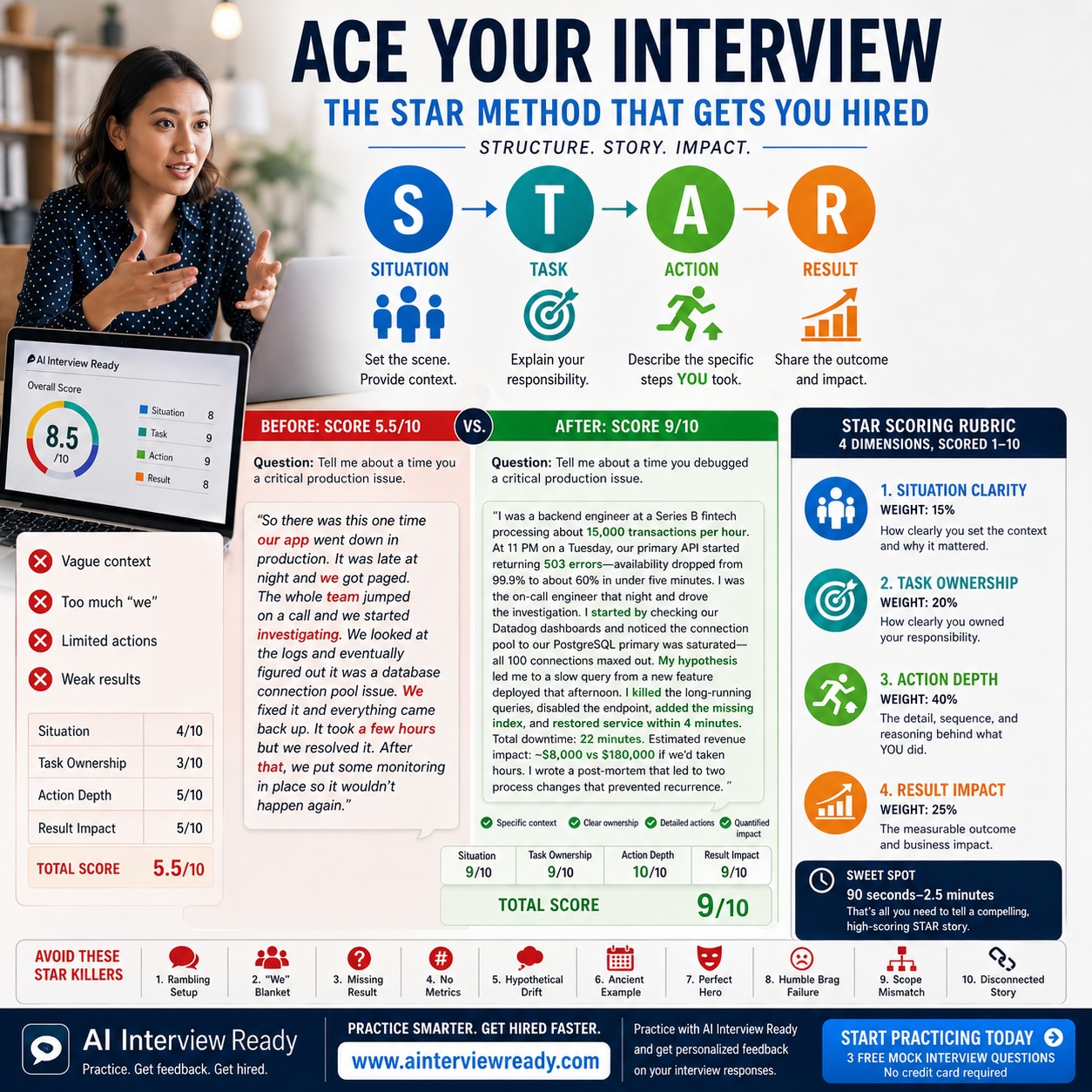
The Complete Guide to the STAR Method: Examples, Scoring, and a Practice System That Actually Works
Real STAR method examples scored against a 4-dimension rubric, plus the 10 mistakes that kill behavioral answers and a system to practice them right.

Why You Must Practice Interviews Out Loud: The Science of AI Speech Coaching
Passive reading fails as interview prep—verbal practice succeeds. 74% of candidates report mock interviews are most helpful. Learn why speaking answers aloud with AI speech coaching is the critical factor in converting preparation into job offers.

Behavioral Interview Questions: AI Analysis of Top Patterns and Winning Answers
Discover how AI analyzes thousands of behavioral interview questions to identify winning patterns and help you craft compelling STAR method responses.