
Interview Tomorrow? A 60-Minute Last-Minute Preparation Plan
A timed plan for the night before: three role priorities, two honest stories, one spoken rehearsal and a practical checklist you can use without an account.
AI Interview Ready
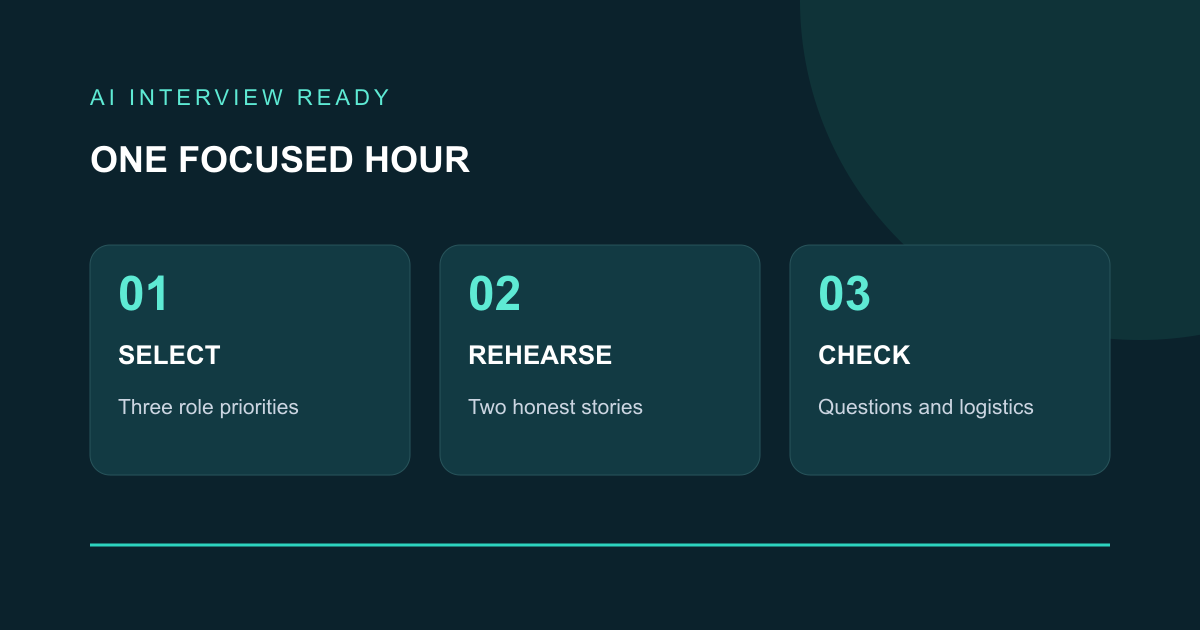
If your interview is tomorrow, use this hour to make your existing experience easier to explain. Open the invitation, job description and the CV you submitted. Set a timer. By minute 60, aim to have a short introduction, two usable stories, two questions for the employer and confirmed logistics.
| Minutes | Action | Leave with |
|---|---|---|
| 0–5 (5 min) | Read the invite; confirm stage, format, time zone and instructions. | A clear target for this interview. |
| 5–15 (10 min) | Choose three role requirements; check the employer's own product/about page. | Three evidence prompts and one specific reason for your interest. |
| 15–30 (15 min) | Match requirements to your experience; outline two short STAR stories. | Actions you owned and outcomes you can support. |
| 30–45 (15 min) | Say an introduction and both stories aloud; score and retry the weakest answer. | A clearer second attempt, without reading a script. |
| 45–55 (10 min) | Prepare two questions; check your connection, route or equipment. | Questions and a workable arrival/joining plan. |
| 55–60 (5 min) | Put the essentials on one card, set reminders and stop adding material. | A concise reference for tomorrow. |
This is a suggested routine, not a guarantee of interview coverage or a substitute for specialist preparation. If the invite names a coding task, case or presentation, prioritise those instructions. Use the story block to rehearse a relevant problem or presentation decision; do not spend the whole hour on generic behavioral questions.
Only 15 minutes? Use this fallback
- 0–3: confirm when, where and what kind of conversation you are joining; pick the two most important role requirements.
- 3–7: write one evidence note for each requirement: your responsibility, action and observed result.
- 7–12: say a short introduction and your strongest example aloud once; repeat the least clear part.
- 12–15: write one question about the role, check the link or route, and put the invite and CV where you can find them.
Do not use the fallback to skim fifty answers. Choose a few facts you can explain accurately. If tomorrow is an initial recruiter call, the phone screen guide helps you focus on short answers, motivation and practical details.
Minutes 0–15: narrow the target
Start with the invitation rather than a general question list. Who is meeting you? Does it mention a recruiter screen, portfolio review, technical exercise or hiring manager discussion? An unfamiliar name is not proof of the person's role; use the invitation and public company information, and note anything still unclear.
Then mark three requirements in the posting. Choose work you would actually do, such as “investigate onboarding drop-off,” rather than broad traits such as “dynamic team player.” Write down what you have done that relates to each. Check the employer's own website for what it sells or provides, who it serves and one detail that explains your interest. Treat unknowns as questions, not facts.
If interpreting the posting is your main difficulty, use the detailed job-description preparation guide. Tonight, limit yourself to three priorities so there is still time to practise.
Minutes 15–30: a completed business analyst example
Everything in this example is fictional and illustrative. Alex is applying for a business analyst role at a subscription software company. The imaginary posting asks for requirements gathering, analysis of onboarding problems and coordination with engineering. These are practice themes, not predicted interview questions.
| Requirement | Experience evidence | Preparation cue |
|---|---|---|
| Clarify conflicting requirements | Mapped Sales and Operations handoffs; agreed an owner and acceptance criteria for each step. | Explain one disagreement and your decision process. |
| Investigate onboarding drop-off | Checked an activation report against support records; found an event-definition error before proposing a product change. | Separate a measurement issue from a customer issue. |
| Work with engineering | Walked through edge cases with an engineer and split a request into a pilot and a later release. | Show how you made a requirement testable. |
Story 1: resolving conflicting requirements
Situation: “Sales wanted a shorter account handoff; Operations needed enough information to support it.” Task: “I had to agree the minimum requirements for a pilot.” Action: “I mapped both teams' steps, separated essential fields from preferences, and walked through missing-data cases with an engineer. I wrote acceptance criteria and got both owners to approve them.” Result: “The pilot launched with one shared checklist. A later review found an unclear escalation owner, which I added before the wider rollout.”
This one story covers requirements and engineering coordination. Alex should be ready to explain which fields were essential and who made the final decision. The story needs no invented efficiency percentage.
Story 2: challenging an apparent onboarding problem
Situation: “An activation dashboard appeared to show a drop after a release.” Task: “I was asked to identify where new users were getting stuck.” Action: “I compared the event definition before and after release, checked a small set of support records and asked an engineer to inspect event delivery. We found the completion event had changed, so I documented the difference and requested a corrected report.” Result: “The corrected report no longer showed that apparent drop. We avoided prioritising a redesign on that evidence; we still needed further research into the remaining support complaints.”
A useful result can be a better decision or a corrected measurement. Describe its limits. For a fuller explanation of story structure, read the STAR method guide; your task tonight is to produce two speakable examples, not a library of scripts.
Questions that follow from this evidence
- “Which onboarding decisions would this analyst own, and which would need a product manager's approval?”
- “What evidence would tell you that the new analyst was doing useful work in the first three months?”
These questions help Alex check the real role against the posting. They also follow naturally from the work Alex just described.
Minutes 30–45: rehearse in priority order
You can do this without a practice tool: read the question, put your notes face down, start a timer and speak. Use a phone recorder only if you want to hear yourself back. Do not read a polished answer into the microphone and count that as recall practice.
- Opening: “Tell me about yourself and why this role.” Aim for a short account of your relevant work, one proof point and your reason for applying.
- Core evidence: “Tell me about work that matches this role's main priority.” Use the first story and answer the question directly.
- A complication: “Tell me about a disagreement, mistake or uncertain result.” Use the second story if it fits; explain the limit or learning honestly.
Use the first three minutes for the opening, four for the first story, four for the second, and four to score and retry the weakest part. These timings are practice constraints, not universal answer-length rules. Listen for the question the interviewer actually asks tomorrow and leave room for follow-ups.
Simple self-check: give each answer one point for answering the question, one for a specific action you owned, one for an outcome you can support and one for a clear connection to the role. Mark missing items, then change one thing on the next attempt. This 0–4 checklist is an editing aid, not a validated assessment or hiring prediction.
Use three questions for tomorrow’s role
Create an account and enter the role or job description; a CV is optional. The free start gives three tailored questions with text answers and feedback, without a card.
Minutes 45–60: remove practical friction
- For a call: check the meeting link, time zone, microphone, charger and a backup contact method. Check the camera if video is expected. Use a quiet place where you can hear clearly.
- For an in-person meeting: confirm the address, journey, entry instructions and what to bring. Plan an arrival buffer appropriate to the route.
- For either format: keep the CV you submitted, the role description and your two questions available. Set an alarm/reminder. Note whom to contact if something fails.
Keep questions specific to what you need to learn: ownership, priorities, team working style and next steps. If you need a fuller equipment checklist, use the remote interview guide.
Copy this one-page preparation card
Copy the lines below into a note or onto paper. Use keywords rather than paragraphs, so you can listen during the conversation.
ROLE / COMPANY:
TIME + TIME ZONE / FORMAT / CONTACT:
STAGE / EXERCISE INSTRUCTIONS:

THREE PRIORITIES → MY EVIDENCE:
1.
2.
3.

OPENING: relevant work → proof → why this role
STORY A: situation/task → my action → result + limit
STORY B: situation/task → my action → result + limit
GAP I WILL EXPLAIN HONESTLY:

TWO QUESTIONS FOR THEM:
1.
2.

LINK OR ROUTE / BACKUP PLAN:
ONE CHANGE AFTER MY SPOKEN REHEARSAL:
What an hour cannot replace
You cannot credibly acquire a missing technical skill, learn an unfamiliar industry in depth or manufacture experience tonight. If a skill gap comes up, distinguish what you have done, what you have only studied and how you would approach learning it. Do not present a tutorial project as production responsibility.
You also cannot prepare every possible question. Leave a short list of unknowns to ask about, stop expanding the material at minute 60, and use the card to retrieve the evidence you already have. The useful finish line is a clearer explanation and a workable plan for attending tomorrow.
Turn your role notes into text practice
Try three tailored questions free. Rehearse aloud yourself, then type your answer for feedback. In-app speech-to-text requires Plus or Pro.
Start free text practice →Share this article:
Ready to ace your next interview?
Practice with AI Interview Ready and get personalized feedback on your interview responses.
Start Practicing TodayRelated Articles
Recruiter Phone Screen: Questions, Short Answer Examples and a 30-Minute Practice Plan
Prepare for the first recruiter conversation: explain your fit briefly, give one concrete example and clarify expectations before the next stage.
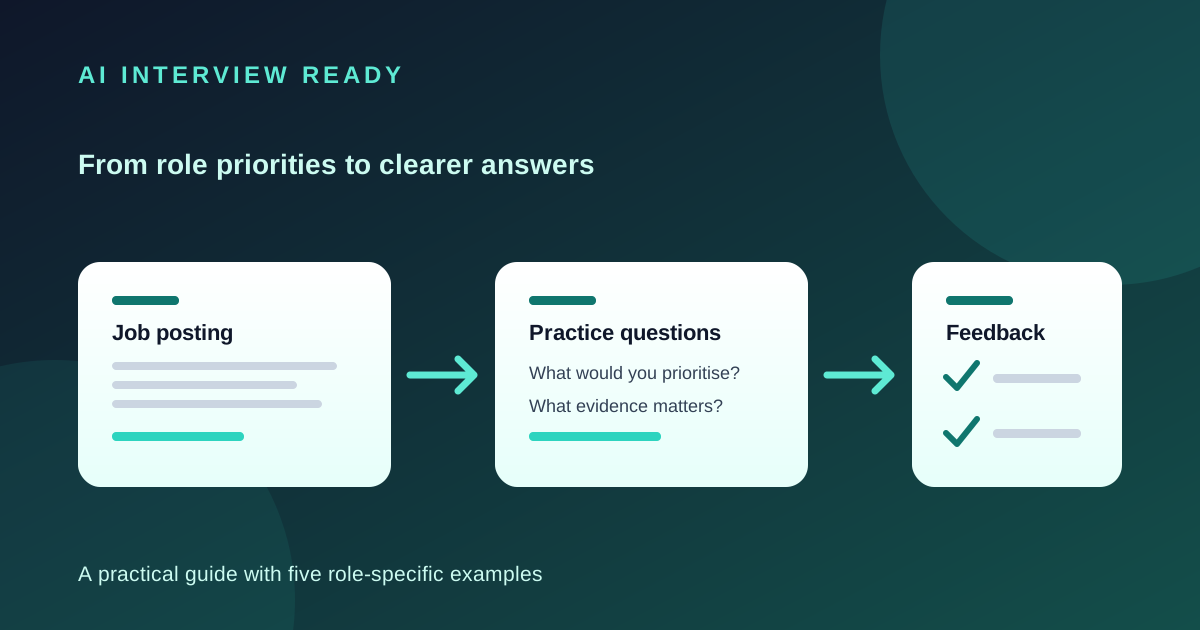
How to Prepare for an Interview From the Job Description (With 5 Role Examples)
A practical way to turn any job posting into likely discussion themes, stronger examples from your experience, and a focused practice session.
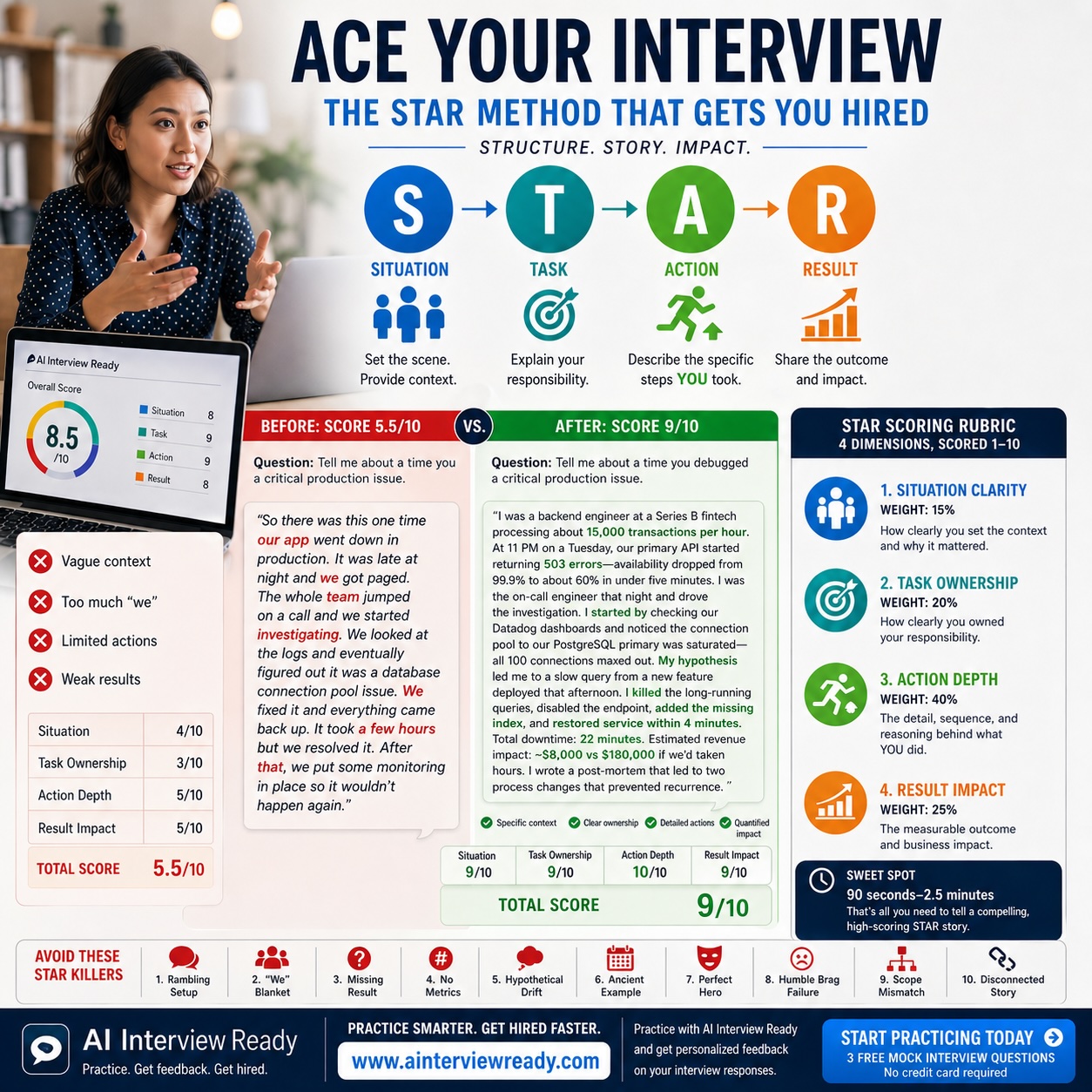
The Complete Guide to the STAR Method: Examples, Scoring, and a Practice System That Actually Works
Real STAR method examples scored against a 4-dimension rubric, plus the 10 mistakes that kill behavioral answers and a system to practice them right.