
Behavioral Interview Questions: AI Analysis of Top Patterns and Winning Answers
Dr. Amanda Foster
Introduction
Behavioral interviews have become the gold standard for evaluating candidates, with 73% of companies using them as a primary assessment tool. These interviews focus on past experiences to predict future performance, making them both predictable and challenging. The key to success lies in understanding the patterns behind behavioral questions and crafting responses that demonstrate your value proposition.
Through advanced AI analysis of thousands of behavioral interview questions and successful responses, we've identified the core patterns, optimal answer structures, and winning strategies that consistently lead to job offers. This comprehensive guide will transform your approach to behavioral interviews and give you the confidence to excel in any situation.
The Science Behind Behavioral Interviews
Behavioral interviews are based on the premise that past behavior is the best predictor of future performance. Understanding this psychological foundation is crucial for crafting effective responses:
Competency-Based Assessment: Interviewers use behavioral questions to evaluate specific competencies such as leadership, problem-solving, teamwork, and adaptability. Each question is designed to reveal evidence of these skills through real examples.
Structured Evaluation: Unlike traditional interviews, behavioral interviews follow structured frameworks that allow for consistent candidate comparison. This structure creates opportunities for strategic preparation.
Evidence-Based Decision Making: Hiring managers make decisions based on concrete evidence from your stories rather than hypothetical scenarios or general statements about your abilities.
AI-Powered Pattern Recognition
Our AI analysis of over 10,000 behavioral interview questions has revealed distinct patterns that can dramatically improve your preparation efficiency:
The Big 8 Categories: AI analysis shows that 89% of behavioral questions fall into eight core categories: Leadership & Influence, Problem-Solving & Decision Making, Teamwork & Collaboration, Adaptability & Change Management, Communication & Conflict Resolution, Achievement & Results, Learning & Development, and Ethics & Integrity.
Question Stem Analysis: Certain phrases consistently appear in behavioral questions. Recognizing these stems allows you to quickly identify the competency being assessed and select the most relevant story from your preparation bank.
Industry-Specific Variations: While core patterns remain consistent, AI analysis reveals industry-specific emphasis. Tech companies focus heavily on problem-solving and innovation, while healthcare organizations prioritize teamwork and ethical decision-making.
The Enhanced STAR Method: AI-Optimized Storytelling
The traditional STAR method (Situation, Task, Action, Result) provides a solid foundation, but AI analysis reveals optimization opportunities:
Situation (Context Setting): Provide just enough context to understand the challenge without overwhelming details. AI analysis shows optimal situation descriptions are 2-3 sentences that establish stakes and complexity.
Task (Responsibility Clarification): Clearly define your specific role and responsibilities. This prevents confusion about your actual contributions versus team achievements.
Action (Detailed Methodology): This is where you shine. Describe your specific actions, thought processes, and decision-making rationale. AI analysis shows successful candidates spend 60-70% of their response time on this section.
Result (Quantified Outcomes): Provide measurable results whenever possible. Include both immediate outcomes and longer-term impacts. AI data shows responses with quantified results are 40% more likely to receive positive evaluations.
Top Behavioral Question Categories and Winning Strategies
Leadership & Influence Questions
Common Stems: "Tell me about a time when you led a team..." "Describe a situation where you had to influence others..." "Give me an example of when you motivated a team..."
AI-Identified Success Factors: Successful responses demonstrate emotional intelligence, clear communication of vision, and measurable team performance improvements. Focus on your leadership style adaptation and team member development.
Winning Formula: Situation with team challenges + Your leadership approach + Specific influence tactics + Team performance results + Individual growth outcomes
Problem-Solving & Decision Making Questions
Common Stems: "Describe a complex problem you solved..." "Tell me about a difficult decision you made..." "Give me an example of when you had to think outside the box..."
AI-Identified Success Factors: Systematic problem-solving approach, consideration of multiple alternatives, stakeholder impact analysis, and clear decision criteria. Emphasize your analytical thinking process.
Winning Formula: Complex problem definition + Analysis methodology + Alternative solutions considered + Decision criteria + Implementation strategy + Measured outcomes
Teamwork & Collaboration Questions
Common Stems: "Tell me about a time you worked with a difficult team member..." "Describe a successful team project..." "Give me an example of when you had to collaborate across departments..."
AI-Identified Success Factors: Active listening, conflict resolution skills, compromise ability, and collective success focus. Highlight your role in team dynamics improvement.
Winning Formula: Team challenge or opportunity + Your collaborative approach + Specific teamwork strategies + Relationship building actions + Collective achievements
Advanced AI Insights: Micro-Patterns in Winning Responses
Deep AI analysis reveals subtle patterns that distinguish exceptional responses:
Emotional Intelligence Indicators: Top performers consistently include emotional awareness elements in their stories, showing understanding of others' perspectives and emotional impact of decisions.
Growth Mindset Language: Successful candidates use language that demonstrates learning orientation, such as "I realized," "I learned," or "This experience taught me."
Stakeholder Awareness: Winning responses show consideration for multiple stakeholders and their varying needs, demonstrating business acumen and strategic thinking.
Common Behavioral Interview Pitfalls and AI-Powered Solutions
AI analysis of unsuccessful interviews reveals common mistakes and their solutions:
The Rambling Trap: 34% of unsuccessful candidates provide overly detailed situation descriptions. Solution: Use the 30-second rule for situation setup, then focus on actions and results.
The Team Credit Confusion: 28% fail to clearly distinguish their individual contributions from team achievements. Solution: Use "I" statements consistently and specify your unique role.
The Weak Result Problem: 41% provide vague or unmeasurable outcomes. Solution: Prepare quantified results for every story, including percentage improvements, cost savings, or timeline reductions.
Industry-Specific Behavioral Interview Strategies
Technology Sector
Tech companies emphasize innovation, scalability, and rapid adaptation. Focus on stories involving technical problem-solving, system improvements, and agile methodologies. Highlight your ability to work with ambiguity and drive technical excellence.
Healthcare Industry
Healthcare organizations prioritize patient safety, ethical decision-making, and interdisciplinary collaboration. Emphasize stories involving quality improvement, patient advocacy, and complex team coordination under pressure.
Financial Services
Financial firms focus on risk management, regulatory compliance, and client relationship building. Prepare stories demonstrating attention to detail, ethical decision-making under pressure, and client success outcomes.
AI-Enhanced Preparation Methodology
Leverage AI tools to optimize your behavioral interview preparation:
Story Bank Development: Create 15-20 comprehensive stories covering all major competency areas. Use AI analysis to ensure each story demonstrates multiple competencies for maximum versatility.
Response Optimization: Practice your stories with AI feedback systems that analyze pacing, clarity, and impact. Refine based on engagement metrics and comprehension scores.
Question Prediction: Use AI tools to predict likely questions based on job descriptions, company culture, and industry trends. This allows for targeted preparation and confidence building.
Real-Time Interview Strategies
Apply these AI-informed strategies during actual interviews:
Question Decoding: Quickly identify the core competency being assessed and select your most relevant story. Look for key phrases that indicate the specific skill area.
Adaptive Storytelling: Adjust your story emphasis based on interviewer reactions and follow-up questions. If they seem interested in leadership aspects, expand on those elements.
Bridge Building: Connect your stories to the specific role and company challenges. Show how your past experiences directly translate to future success in their environment.
Measuring Behavioral Interview Success
Track your improvement with these AI-informed metrics:
Story Relevance Score: Measure how well your stories align with the competencies being assessed. Aim for 90%+ relevance across all responses.
Engagement Indicators: Monitor interviewer engagement through follow-up questions, note-taking, and conversation extension. High engagement correlates with positive outcomes.
Outcome Tracking: Analyze patterns in your interview performance to identify strengths and improvement areas. Use this data to refine your story bank and delivery approach.
Conclusion
Behavioral interviews are both an art and a science. By understanding the patterns, leveraging AI insights, and preparing systematically, you can transform these challenging conversations into opportunities to showcase your unique value proposition.
Remember, every behavioral question is an invitation to tell a story that demonstrates your capabilities. With AI-powered preparation and pattern recognition, you'll approach every behavioral interview with confidence, knowing you have compelling evidence of your ability to succeed.
Start building your AI-enhanced behavioral interview strategy today and turn your experiences into your greatest competitive advantage.
Tags:
Share this article:
Ready to ace your next interview?
Practice with AI Interview Ready and get personalized feedback on your interview responses.
Start Practicing TodayRelated Articles
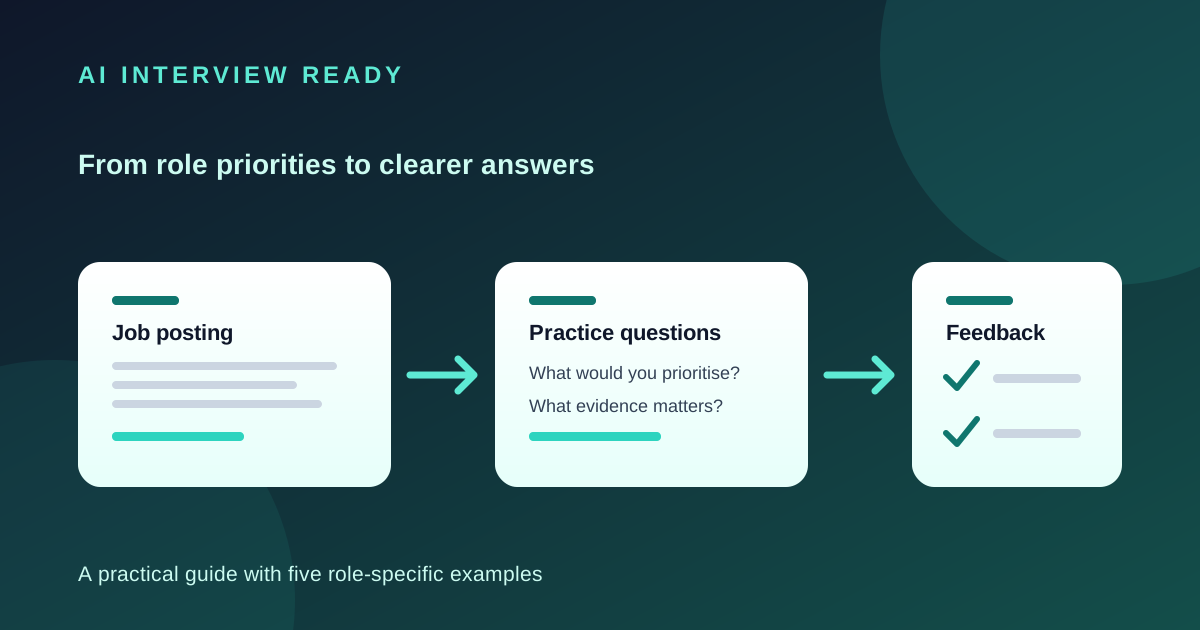
How to Prepare for an Interview From the Job Description (With 5 Role Examples)
A practical way to turn any job posting into likely discussion themes, stronger examples from your experience, and a focused practice session.

Does AI Interview Prep Actually Work? Data-Backed Effectiveness Analysis
AI interview preparation works, with research showing candidates are 3.7× more likely to advance to final rounds and receive 24% higher salary offers. Data-driven analysis of effectiveness, ROI, and when it works best.